
ACTION 9 OF 16
How to build honest “us vs. competitor” pages that AI cites
SHORT ANSWER
Pick the 2–3 competitors AI mentions next to you most often. Build a comparison page for each one with a table of 6–8 criteria, prices, and honest downsides. Then add a “Best [service, product, software] for [use case]” page that lists several options, including yours.
- Time: 1 day
- Owner: Marketer
- Impact: ≈ +4–8% Coverage ¹
Kyrylo Poltavets, Founder of Dabudai · LinkedIn
Published · Updated
Why do comparison pages matter for AI search?
For buying-intent queries like “which is better,” “alternatives,” or “best for,” AI often pulls from comparison pages. It cites honest ones. It skips thinly disguised ads where you win on every point.
How to build a comparison page, step by step
- Pick the 2–3 competitors AI mentions next to you most often.
- Build a separate page for each one: “[You] vs. [Competitor].” Compare the two of you on 6–8 criteria. Always include prices and who each option is best for.
- Say honestly where the competitor is stronger and who should pick them instead.
- Add a “Best [category] for [use case]” page with several options, including yours.
- Show when the page was last updated and who checked the data.
Pair this with: Get into third-party “best of” lists
Why does AI cite comparison pages, and which ones?
When someone asks “which is better, X or Y,” AI search breaks the question into several sub-queries, like “X vs Y,” “X alternatives,” and “X pricing.” Then it looks for pages that answer each one. A page that answers one of those sub-queries directly has a shot at the answer. To find the sub-queries in your niche, see “Answer the queries where competitors show up and you don’t”. [Google]
For these queries, AI gathers facts from several kinds of sources: review sites, tech media, third-party lists, and the companies’ own sites. Then it pulls them together into a comparison.
12–24%
of links in AI answers about B2B software point to the companies’ own sites
Source: study ↗
Your comparison page is one of those sources. AI will use its facts if they match what others say about you: price, features, and ratings on review sites. So link every rating in your table to the review profile it comes from, and collect reviews where AI reads them (Action 11). [study]
Which comparison pages does AI pick more often?
- Pages with prices and specific specs. Vague wording and missing specs make a model less likely to use the page. [SIGIR ’26]
- Pages with evidence: numbers with a source, and links to the pages where you got the competitor’s data. [SIGIR ’26]
- Fresh pages. Among the pages AI cites, comparison pages are some of the most recently updated. Show the date you checked the data and update the page every 3 months (Action 10). [study]
Which comparison pages should you build, and when?
| Page type | Target queries | Must include |
|---|---|---|
| “[You] vs. [Competitor]” | “X or Y,” “X vs Y,” “is X better than Y” | A table with 6–8 criteria, prices, and a “When to choose [Competitor]” section |
| “[Competitor] alternatives” | “X alternatives,” “tools like X,” “instead of X” | 4–6 options and the reasons people switch (price, a feature, region). You’re one of the options, not the only one |
| “Best [category] for [use case]” | “best X for Y,” “top X for Y” | Selection criteria, 5–10 options, who each one is for, and the date you checked the data |
Start with the competitor AI names alongside you most often. You can see who that is in the Competitors section for free on the platform (7 days). Next, build an alternatives page for your strongest competitor. People searching for it are already ready to switch.
What should you include in a comparison table?
- Price, with the date you checked it and what each plan includes. Having a price is one of the strongest signals a model uses to pick a source. [SIGIR ’26]
- Best for: company size, niche, and how experienced the user needs to be.
- 3–4 key features customers actually choose on. Take them from questions you hear in sales and support, not from your own list of selling points.
- Limits: usage caps, languages, regions, minimum contract length.
- Support and onboarding: channels, languages, and how long it takes to see first results.
- Integrations your audience uses.
- Rating on review sites, with a link to the profile.
Be specific: “up to 5 users, $49/mo,” not “flexible pricing.” Models skip vague wording because they can’t quote it as a fact.
Is it legal to compare yourself to competitors?
In the EU, comparative advertising is allowed if it compares objective, verifiable, and material features and isn’t misleading (Directive 2006/114/EC). [EU Directive] In practice, that means:
- take the competitor’s data from their public website and link to it;
- show the date you checked the data next to the table;
- don’t use the competitor’s logo or name in a way that suggests you’re affiliated;
- update the page when the competitor changes prices or plans (Action 10).
This isn’t legal advice. If you compare on price or call yourself “the best,” run the wording past a lawyer.
Comparison table template
Criteria | [You] | [Competitor]
Price | from $X/mo | from $Y/mo
Best for | [customer type] | [customer type]
[Feature 1] | Yes | Yes
[Feature 2] | Yes | No
[Feature 3] | No | Yes
Support | [channels, languages] | [channels, languages]

When [Competitor] is the better choice: [honest answer].
Data checked: [date], [name].
How do you know your comparison pages are ready?
You have at least two comparison pages with a table, prices, and honest downsides, all updated in the last 3 months.
What’s the most common mistake on comparison pages?
A comparison where you win on every point. People and models both read that as an ad.
How do you know which competitors to compare against?
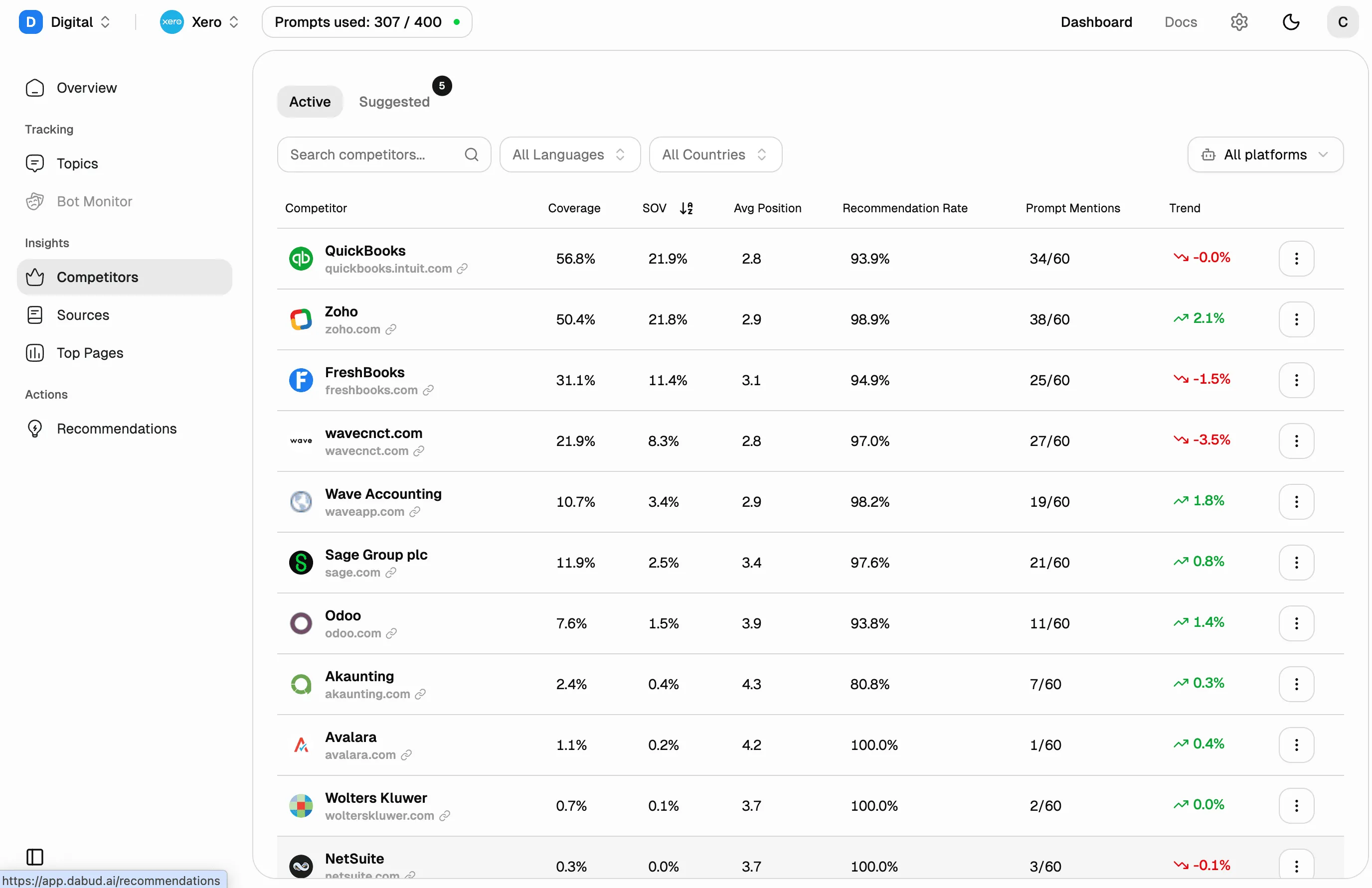
Check for free on the platform (7 days) which brands AI names next to you in answers to “best [category] for [use case]” and “[competitor] alternatives.” To check manually, run 5–10 of these queries in AI and note who shows up most often.
If you use Dabudai, the Competitors section shows which competitors AI names for your queries and how often. That’s your ready-made list for comparison pages.
app.dabud.ai · Competitors
No account yet? Your first brand data shows up within 20 minutes of signing up. The first 7 days are free.
Common questions about comparison pages
Can I mention competitors on my own site?
Yes, as long as the comparison is fair and the facts are checked. Show the date you checked the data.
How many comparison pages should I build?
Start with your 2–3 most common matchups. Two honest, up-to-date pages beat ten stale ones.
What if a competitor is better on some criteria?
Say so, and explain who should pick them. That’s exactly what makes the page convincing to both people and models.
What Dabudai customers say
★★★★★
0 → 6 sales from ChatGPT in three weeks
“We’d never had a single sale from ChatGPT. Just three weeks after we put Dabudai’s recommendations in place, we got our first 6 sales.”
Anastasia Bezugla
· Marketing Manager, coffee shop
GO DEEPER
Learn more in the Learning Center inside the Dabudai platform: a breakdown with examples by niche and a check on your own data.
Open the Learning Center in Dabudai →
The Learning Center is open during the free 7-day trial. No credit card needed.
Sources
[Google] Google: How AI features in Search work (query fan-out) ↗
[study] Growfusely: Which sources ChatGPT and Perplexity cite for B2B software queries, July 2026 ↗
[SIGIR ’26] SIGIR ’26: 252,000 controlled source comparisons ↗
[study] Seer Interactive: Content recency and AI visibility, 2026 ↗
[EU Directive] Directive 2006/114/EC on misleading and comparative advertising ↗
¹ Estimated impact comes from Dabudai’s analysis of 350,000 AI answers across 2,300 websites, October 2026. Your results depend on your niche, competitors, and starting point.