
ACTION 8 OF 16
How to write pages AI cites: answer first, then numbers and sources
SHORT ANSWER
Answer the question in your headline in the first 2–3 sentences, with no intro. Add 2–3 numbers with sources and a quote from a named expert, and break the text into short sections with question-style subheadings. In a peer-reviewed study, these techniques raised visibility in AI answers by up to 40%.
- Time: 1 hour per page
- Owner: Content marketer
- Impact: ≈ +4–8% Coverage ¹
Kyrylo Poltavets, Founder of Dabudai · LinkedIn
Published · Updated
Why does AI cite some pages and skip others?
A model looks for the passage that answers the question precisely, and uses it. If the answer is buried in paragraph five after an “In this day and age…” intro, it’s easier to skip. And a number without a source is no better than an unsupported claim.
Which page elements matter most for GEO?
- Rewrite the top of the page so the first 2–3 sentences answer the headline question, with no intro.
- Add 2–3 specific numbers with a source: your own data or third-party research, with a link.
- Add a quote from an expert, with their name and job title.
- Break the text into short sections with question-style subheadings.
- Wherever you compare things, use a table or a list.
Pair this with: Show when the page was last updated · Add your own data
What increases AI citations the most?
These are the page elements that research shows have the strongest effect on GEO: [KDD 2024]
+41%
Expert quotes with a name and job title
Source: KDD 2024 ↗
+34%
Statistics and specific numbers
Source: KDD 2024 ↗
+28%
Simpler, easier-to-read text
Source: KDD 2024 ↗
+27%
Links to sources
Source: KDD 2024 ↗
−8%
Keyword stuffing
Source: KDD 2024 ↗
Keep in mind: the effect was measured as a page’s share of the answer, for pages AI had already found. It isn’t traffic or sales. So these techniques work once a page is already showing up in AI search (see access for AI crawlers, indexing, and sub-queries).
How does AI choose between two pages on the same topic?
When AI picks between two pages on the same topic, here’s what decides it: [SIGIR ’26]
Helps
- a close match to the topic of the question
- a listed price
- a recent date
- claims backed by evidence
- reviews and other social proof
Hurts
- no specs or specifics
- hedging language: “possibly,” “as a rule,” “it depends on many factors”
Barely matters
- formatting: lists and tables instead of plain text
Use tables and lists for your readers. They have almost no effect on what AI picks.
This was a controlled setup where AI chose between two sources, not live search results. But the findings match the study above: specifics backed by evidence win.
What should you check on a page before you publish it?
- The answer to the headline question is in the first 2–3 sentences.
- At least 2 numbers, each with a source and a year.
- An expert quote with a name and job title.
- A price or price range, if the page is about a service or product.
- Specific details instead of generic wording.
- No “possibly,” “as a rule,” or “in this day and age.”
- An author byline and a last-updated date.
Template: the first paragraph, before and after
Before:
“In this day and age, choosing a CRM is an important decision for any business. In this article, we’ll look at…”

After:
“For a team of 10–50 sales reps, a CRM costs $25–80 per user per month. The key selection factor is email and phone integration: in our data, 62% of teams switch CRMs for exactly this reason (survey of 140 customers, 2026).”
How do you check whether AI has started citing a page?
Rewrite 3–5 key pages. After 4–6 weeks, compare how often AI cites them against pages you didn’t touch.
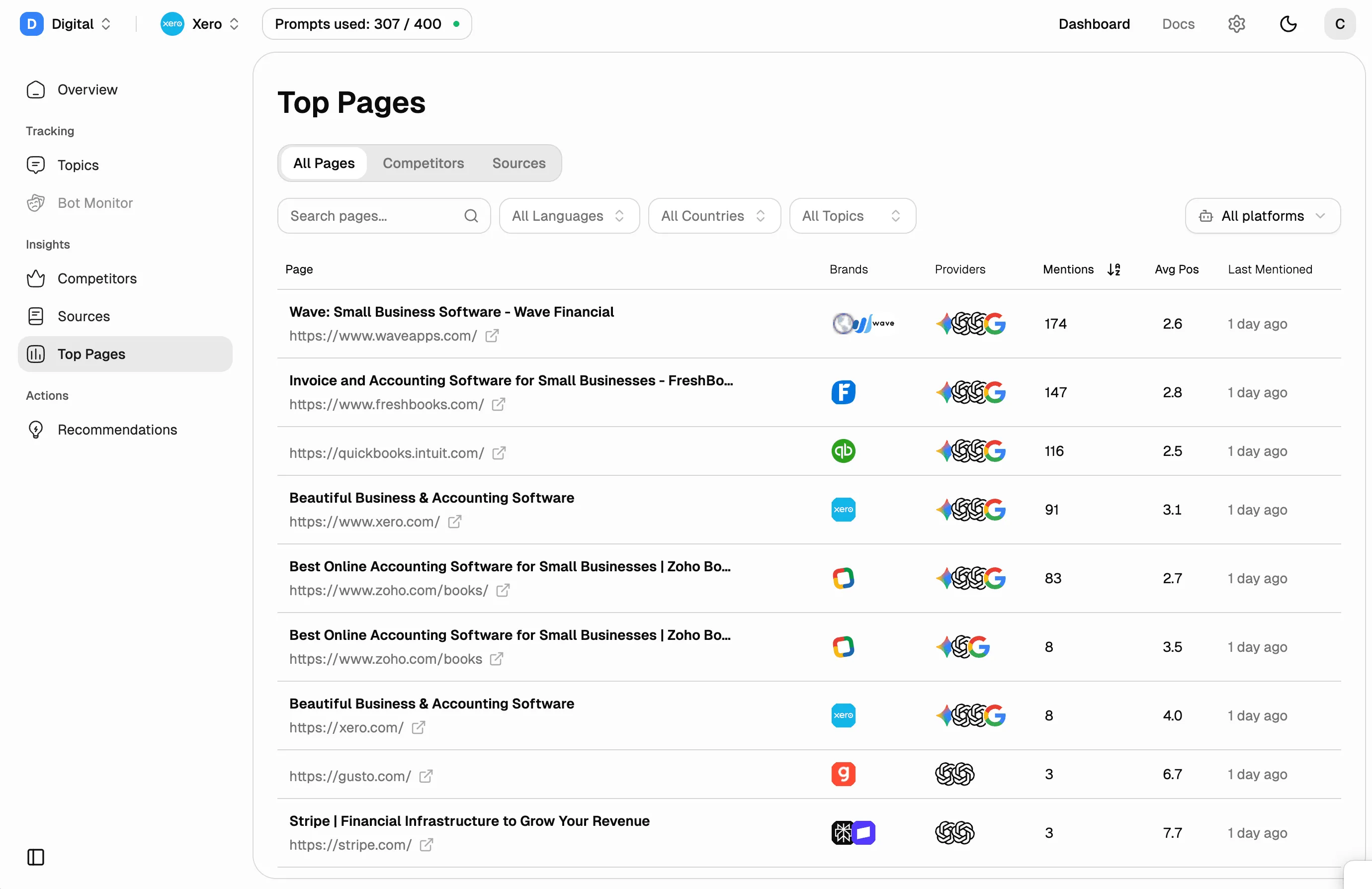
If you use Dabudai, Top Pages shows which pages AI cites and how their citation count changes after a rewrite.
app.dabud.ai · Top Pages
No account yet? Your first brand data shows up within 20 minutes of signing up. The first 7 days are free.
Common questions about writing pages AI cites
Do we need to rewrite every page?
No. Start with the 5–10 pages that bring in leads, plus your answer pages for customer questions.
Where do we get numbers if we don’t have our own data?
Industry research, regulator data, and association reports, always with a link. Later on, run your own survey (Action 16).
Does a short answer at the top hurt SEO?
No. A direct answer up front works for both people and search engines.
What Dabudai customers say
★★★★★
A clear direction, even before the recommendations
“The dashboards are clear and intuitive. They make it easy to see what’s driving our AI visibility.”
Andrew Shestopalov
· Head of Marketing, Hotline
GO DEEPER
Learn more in the Learning Center inside the Dabudai platform, with examples by niche and a check on your own data.
Open the Learning Center in Dabudai →
The Learning Center is open during the free 7-day trial. No credit card needed.
Sources
[KDD 2024] GEO: Generative Engine Optimization (KDD 2024) ↗
[SIGIR ’26] How generative systems choose sources: 252,000 controlled comparisons (SIGIR 2026) ↗
¹ Estimated impact comes from Dabudai’s analysis of 350,000 AI answers across 2,300 websites, October 2026. Your results depend on your niche, competitors, and starting point.