What Is Dabudai and How It Helps Brands Get Recommended in ChatGPT and Other AI

Jump to
AI search has already changed how people choose products, services, and companies.
More and more users don’t Google ten pages anymore — they ask AI directly:
“What are the best tools for …?”
“Compare X vs Y”
“What should I choose for my use case?”
“What are the alternatives?”
And if AI answers don’t mention your brand — or if AI recommends competitors — you lose the customer before they even visit your website.
That’s exactly where Dabudai comes in.
Dabudai is an AI Search Intelligence Platform that helps you become the answer
Dabudai is an AI Search Intelligence Platform built to measure and improve how your brand appears in AI-generated answers across ChatGPT, Gemini (Google AI Overviews), and Perplexity.
It’s not a “dashboard for dashboards.” Dabudai is designed as a clear closed loop:
Measure → Explain → Improve → Validate results
That closed loop is the key difference between Dabudai and most tools on the market.
Why brands lose in AI answers (even when SEO works)
Even if you have strong SEO, a great website, and lots of content, AI can still:
not mention your brand in “best tools” lists
confuse your category or positioning
prefer competitors because they appear in “trusted sources”
use outdated or inaccurate messaging
miss your strongest proof points (case studies, numbers, reviews, comparisons)
The problem is simple:
AI doesn’t answer like Google.
AI answers are shaped by:
sources AI considers “trusted enough”
how consistent your brand information is across the web
how clearly you fit into a category
the quality of your proof (reviews, case studies, citations, media)
how readable and retrievable your content is
Traditional SEO tools don’t explain why AI chose a competitor — and what exactly to change to fix it.
How Dabudai works: the 3-layer platform
1) Context Layer: Brand Truth
The platform helps you collect your company context:
real ICP questions
common objections
competitive comparisons
key messages you want AI to repeat
proof (case studies, numbers, citations, reviews)
This is the foundation. If your Brand Truth isn’t defined, AI will build your narrative for you — and it often won’t be the one you want.
2) Intelligence Layer: measuring AI search output
Next, Dabudai runs query scenarios that match how your buyers actually search:
“best tools for …”
“alternatives to …”
“X vs Y”
“what is the best … for a small team / enterprise”
“how to choose …”
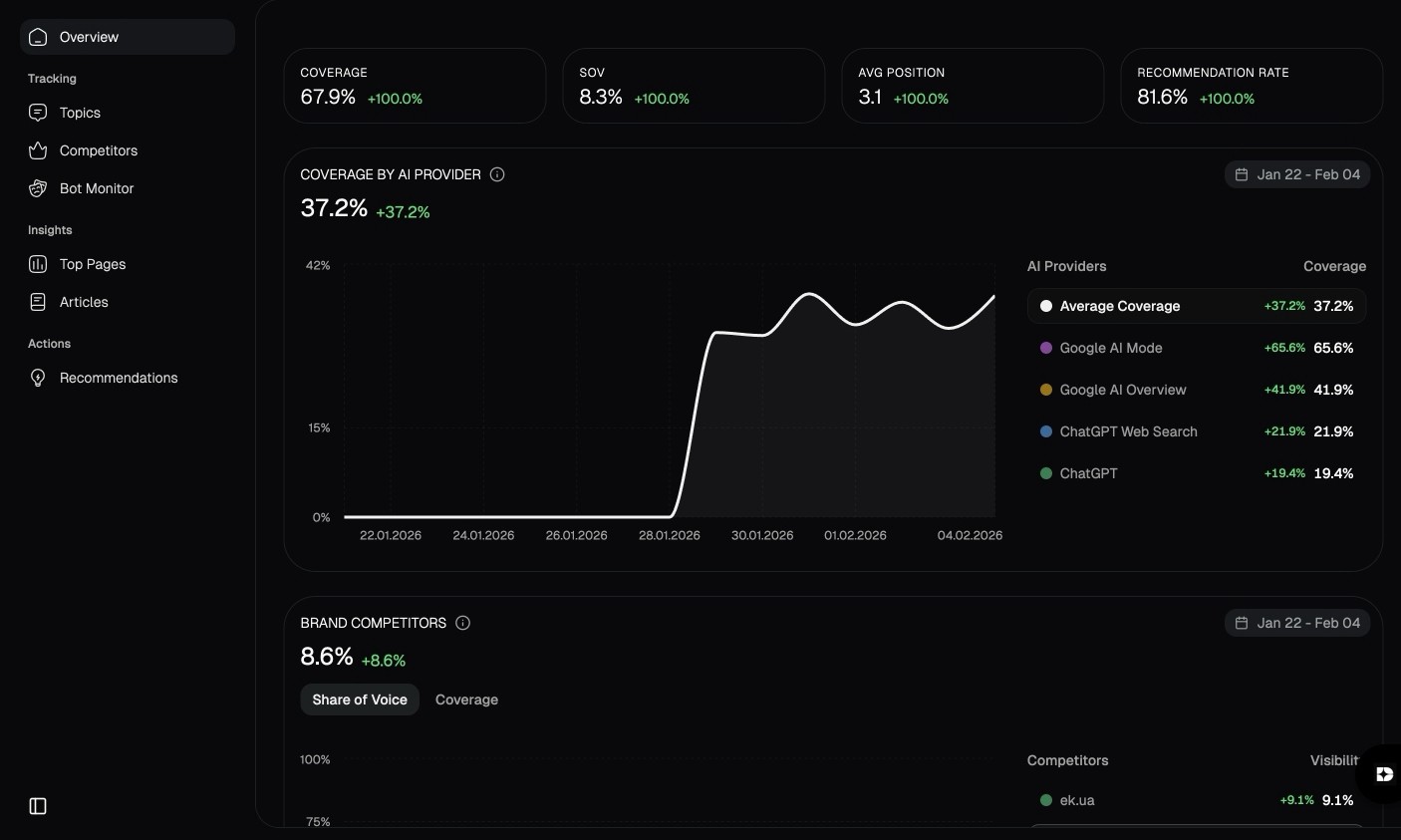
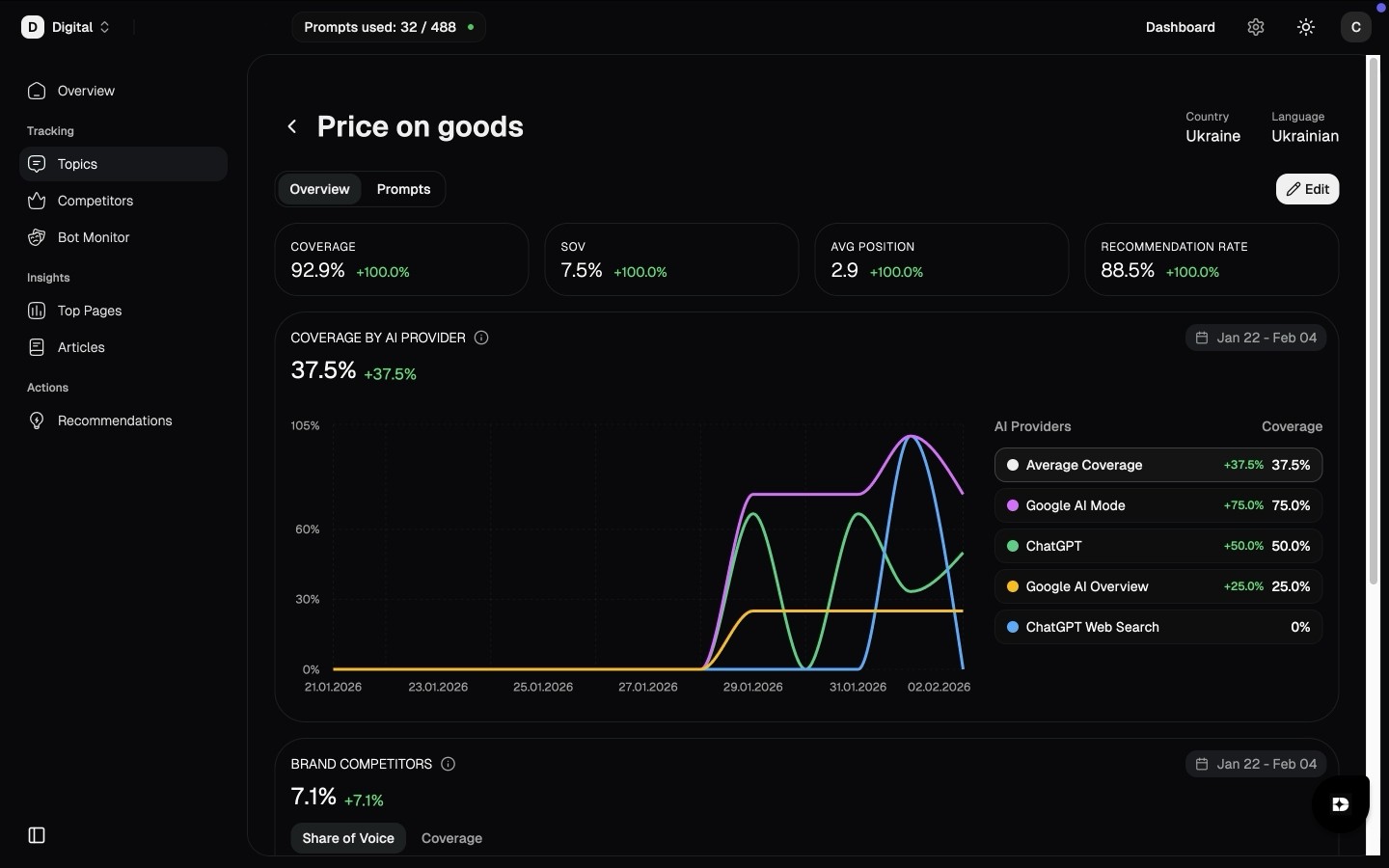
The platform collects AI answers, benchmarks you against competitors, and measures key metrics:
AI Visibility
Share of Voice (AI)
Average Rank Position
Recommendation Rate
Coverage across topics and prompts
AI crawler activity + AI traffic to your website
3) Action Layer: execution and growth
The core value of Dabudai isn’t showing charts.
It’s turning data into a concrete plan:
what to change on your website
what pages to create or rewrite
what topics and content formats will drive the biggest lift
which “trusted sources” to strengthen through PR / media / directories
how to close narrative gaps that make AI “hand your buyer” to competitors
And most importantly: after execution, you can measure the before/after impact.
What Dabudai does better (and why it delivers faster results)
In practice, most teams face the same problem:
They see the data — but they don’t know what to do next.
Dabudai is built to solve exactly that.
1) A clear closed loop: Measure → Explain → Improve
Dabudai is a system designed to prevent teams from getting stuck in monitoring mode.
With Dabudai, you:
measure how your brand appears in AI answers
understand why you win or lose
execute a prioritized plan of improvements
validate how changes impact coverage, Share of Voice, average position, and AI traffic
Why it matters: most tools show “what is,” but don’t lead you to “what to change.”
2) Smart Recommendations in ~10 days (time-to-first-value)
Dabudai focuses not on “insights,” but on Smart Recommendations — a prioritized list of actions.
Recommendations are structured across three execution directions:
Website optimization
Content marketing
Media / third-party outreach
And importantly: you don’t just get generic advice — you get recommendations broken down by topics, prompts, and specific AI systems.
The first Smart Recommendations are typically available in about ~10 days after you start — once the platform collects baseline data and completes competitive benchmarking.
(Timing depends on the number of scenarios and AI models being tracked.)
Why it matters: most teams don’t need more charts — they need a prioritized change list that actually moves AI answers.
3) Optimization for Share of Voice and recommendations — not just mentions
In AI search, “visibility” is only the first level.
What matters most is:
whether AI puts you in the top options
whether AI directly recommends you
whether AI compares you in your favor
That’s why Dabudai focuses on metrics closer to business outcomes:
Share of Voice (AI)
Average Rank Position
Recommendation Rate
Why it matters: being mentioned doesn’t always mean being chosen. Recommendations influence demand, leads, and revenue.
4) AI Visibility Map: company → topics → prompts
Dabudai helps you quickly understand where performance drops:
at the brand level
within specific topics
within specific prompts
across specific AI models (ChatGPT, Gemini, Perplexity)
You can think of it as an AI Visibility Map — a structured view that shows where competitors outperform you and what exactly needs to be improved.
Why it matters: you stop guessing. You see the leverage point and can fix it fast.
5) White-label for agencies and SEO specialists
Dabudai supports a white-label mode for agencies and specialists:
custom domain connection
logo
color palette
client access
analytics under your brand
This takes minutes — and after that you can present the platform as part of your expertise.
Why it matters: white-label increases trust, boosts average deal size, and improves conversion because you look like a team with a real system — not “a freelancer with a spreadsheet.”
What outcomes Dabudai delivers (in the right terms)
Dabudai helps you:
increase your presence share in AI answers (Share of Voice)
rank higher in recommendation lists (Average Position)
earn more direct recommendations (Recommendation Rate)
improve topic coverage across your category
drive more website visits from AI platforms
And most importantly: do it systematically through the measure → explain → improve loop.
Who Dabudai is for
For CMO / Brand / PMM
control over your AI narrative
competitive Share of Voice
a systematic improvement plan
transparent metrics and progress
For Revenue / Sales leadership
understand how AI answers in deal scenarios
strengthen your proof library and battlecards
improve positioning in comparisons
For agencies
multi-client tracking
white-label delivery
ready recommendations and plans for clients
a product that increases LTV and average deal size
FAQ
Is Dabudai an SEO tool?
No. Dabudai doesn’t work as a keyword rank tracker or a classic SEO platform. It measures and improves how AI systems represent your brand in answers and recommendations.
Which AI systems do you support?
Dabudai runs scenarios across major AI platforms, including ChatGPT, Gemini (Google AI Overviews), and Perplexity.
When will I see the first results?
The first Smart Recommendations are typically available in about ~10 days after you start, once the platform collects baseline data and builds competitive benchmarking. After that, results depend on how quickly improvements are implemented.
How is Dabudai different from “AI monitoring dashboards”?
Dashboards show data. Dabudai provides a closed loop: measure → explain → improve → validate before/after. This is not about “seeing” — it’s about improving.
Is Dabudai suitable for agencies?
Yes. Dabudai includes white-label, multi-client mode, and the ability to deliver analytics under your brand.
Conclusion
AI search is a new demand channel. The winners won’t be the brands with “more content,” but the ones who:
measure AI visibility clearly
understand why they lose
execute the right changes quickly
strengthen trust through third-party sources
and continuously validate impact
Dabudai is built for exactly that — so your brand doesn’t just get mentioned, but gets recommended.