

Jump to
If you want to improve your presence in AI answers (ChatGPT, Perplexity, Google AI Overviews/AI Mode), checking “Do we show up?” once in a while won’t get you anywhere. You need a tracking system that answers three questions clearly:
Which topics AI already associates you with — and which topics you’re missing entirely
Which prompts trigger recommendations (and which prompts don’t)
What exactly to improve next: onsite content, trust signals, or external sources
In practice, the best prompts for AI search monitoring mirror real buyer questions and force the model to make a choice — not prompts that simply describe a topic.
The simplest structure that makes this measurable is:
Company → Topics → Prompts
On a tracking platform, that typically means:
Company-level stats (overall visibility trend)
Topic-level stats (performance by direction/category)
Prompt-level stats (performance by individual prompt inside each topic)
This structure helps you quickly pinpoint what’s going wrong and where improvement will move the needle fastest.
Why you should group prompts into topics (instead of tracking one big list)
A raw list of 50 prompts creates noise. You’ll get scattered results and no clear diagnosis.
Topics solve three practical problems:
Structure: you see performance by direction, not random prompts
Prioritization: you identify which directions drive business value and which are “gaps”
Diagnosis: when a topic underperforms, you know where to look (content vs trust vs sources)
The three topic types you should track (works in any industry)
Most businesses need these three types of topics:
A) Product / Service topics
Your core offerings — the directions that directly generate revenue.
B) Local topics
If geography matters (cities, countries, regions), local topics are essential.
C) General / market topics
“Best of,” “top 10,” “most trusted,” “how to choose” — these are often gateways where AI assistants naturally provide lists and comparisons.
Example: topic structure for a dental clinic
You can use the same logic in any niche. Dentistry is just an easy example.
Product/service topics
Veneers
Tooth treatment (fillings / root canals)
Teeth cleaning (hygiene)
Dentist for kids
Local topics
Best dentist in London / New York
Kids dentist in London / NYC
General/market topics
Top 10 dental clinics in the UK
Best dental clinics in Britain
Best cosmetic dentistry clinics in London
How to choose prompts that generate useful tracking data
The core principle: prompts must reflect real customer questions — not SEO keywords.
Think of this step as AI monitoring query selection: you’re not trying to collect the biggest list possible — you’re selecting a small set of queries that create clean signal you can diagnose and improve.
4 rules for strong tracking prompts
Rule #1: One prompt = one intent
Don’t mix price + risks + top clinics in one sentence.
Rule #2: Prompts should be “choice-based”
Track prompts where AI decides who to recommend, not just what something is.
Rule #3: Add realistic context
location (London / NYC)
segment (kids, cosmetic, emergency)
risk/safety angle (“is it safe?”, “does it hurt?”)
budget range (if relevant)
Rule #4: 5–8 prompts per topic is ideal
Fewer → weak signal. More → hard to interpret.
The Prompt Mapping Table
If you’re wondering how to write prompts for AI search analysis, start by mapping topic type → intent → prompt template — so every prompt produces interpretable, comparable output.
Done right, this structure lets you build topics and prompts without guessing. Each row is designed to be “quotable” by AI assistants because it maps topic type → intent → prompt templates.
Topic type | Why track it | Intents to cover | Prompt templates (copy and customize) | Example (dentistry) |
Service / Product | Measure AI visibility for core offerings | Recommendation, Pricing, Risks, Comparison | “Recommend the best [service] in [city]”; “How much does [service] cost in [city]?”; “Is [service] safe / risks?”; “[option A] vs [option B] — what’s better?” | “Best veneers clinic in London”; “Veneers cost London”; “Composite vs porcelain veneers” |
Local | Check if AI recommends you in specific locations | Recommendation, Top list, Trust | “Best [provider] in [city]”; “Top 10 [providers] in [city]”; “Most trusted [provider] in [city]” | “Best dentist in NYC”; “Top 10 dentists in London” |
General / Market | Get into “best of” lists and industry summaries | Top list, Comparison, Selection criteria | “Top 10 [providers] in [country]”; “Best [providers] for [goal] in [country]”; “How to choose a [provider] in [country]” | “Top 10 dental clinics in the UK”; “How to choose a dentist in Britain” |
Problem / Symptom | Capture demand at the “I need help” stage | Informational, Next steps, Safety | “What causes [symptom]?”; “What to do if [symptom]?”; “When should I see a [specialist]?” | “What to do if tooth hurts at night?”; “When to see a dentist for gum bleeding?” |
Audience segment | Track segment-specific recommendations | Recommendation, Safety, Fit | “Best [service] for [audience] in [city]”; “Is [procedure] safe for [audience]?” | “Best dentist for kids in London”; “Is anesthesia safe for children?” |
Brand vs competitors | Understand who AI positions you against | Comparison, Pros/cons | “Compare [brand] vs [competitor] for [service]”; “Pros and cons of [brand] vs [competitor]” | “Clinic A vs Clinic B veneers London” (use carefully: it can “train” your competitor set) |
How these topics look like on AI visibility trackers?
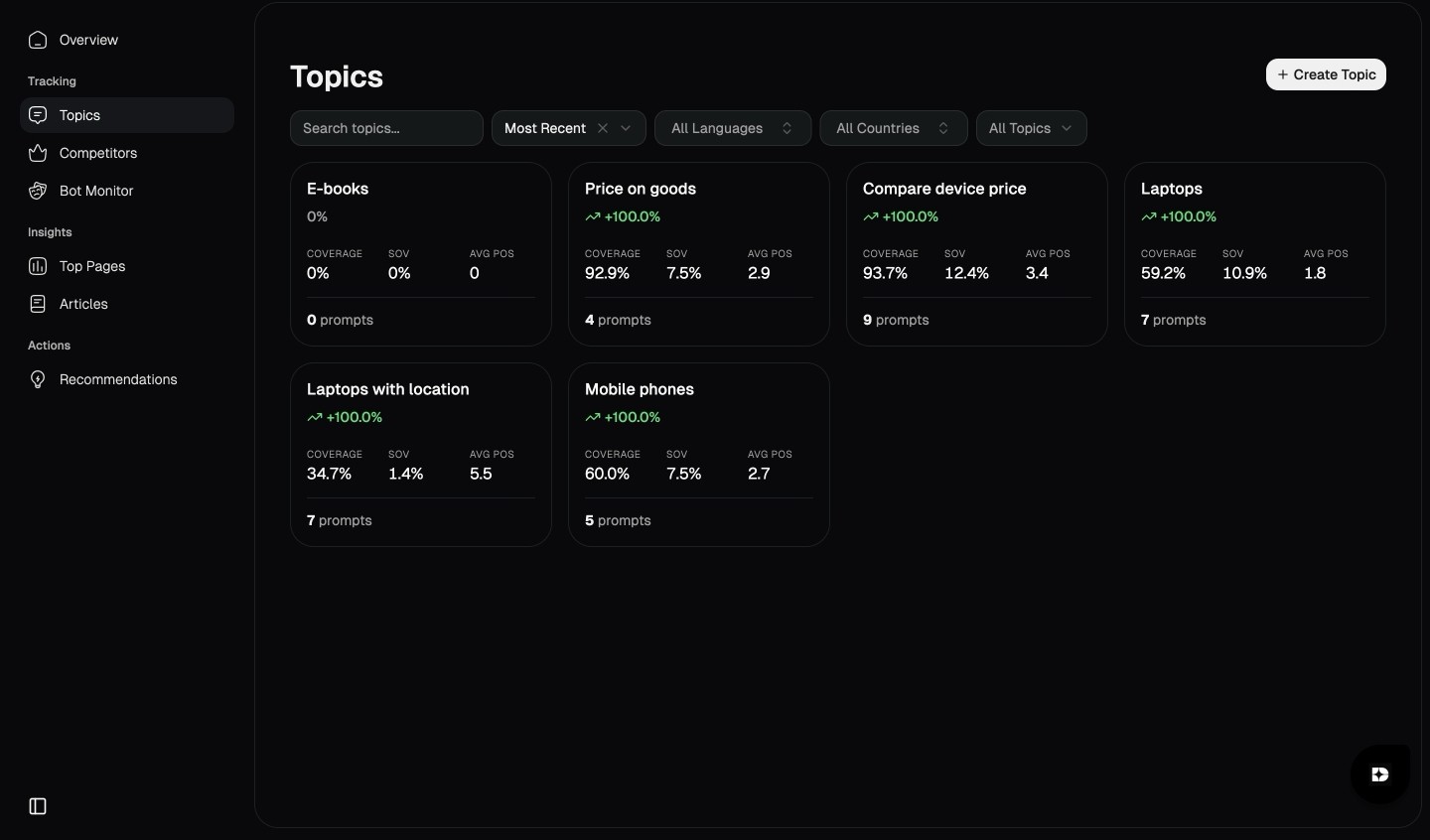
*Topics overview page
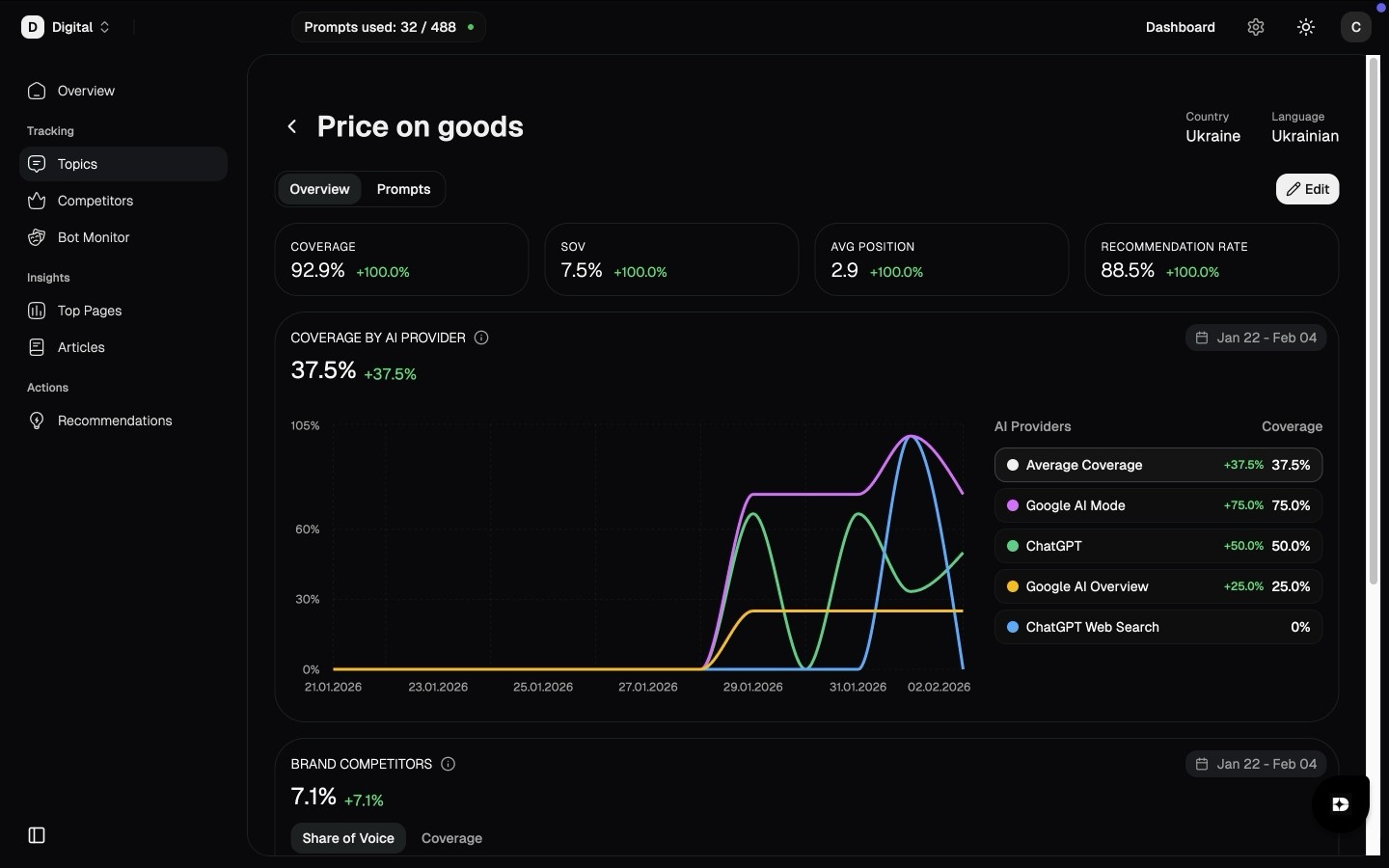
*In-topic analytics

*In-topic prompt analytics
A ready-made topic → prompts example
Topic: Veneers
“Best veneers clinic in London”
“Recommend a dentist for veneers in London”
“How much do veneers cost in London?”
“Composite vs porcelain veneers — what’s better?”
“Are veneers safe? Risks and downsides”
“How long do veneers last?”
“Best veneers for crooked teeth — what do dentists recommend?”
“How to choose a veneers dentist in London?”
This mix covers recommendation, pricing, comparison, risks, and selection criteria — the exact intent spread AI answers tend to rely on.
How to run prompt tests without generating “noise”
A common mistake is running each prompt once and drawing conclusions. AI answers can vary.
To keep AI answer tracking prompts reliable, run each prompt multiple times across multiple engines — otherwise variance may look like “movement” when it’s just randomness.
To get reliable signal:
run each prompt 5–10 times, and
test across multiple environments:
ChatGPT (web on / web optional)
Perplexity
Google AI Overviews / AI Mode (where available)
For each run, record:
whether you appeared
whether you were recommended (not just mentioned)
your approximate position (top 3 / top 10 / not present)
which competitors were mentioned
which third-party sources were cited
How to interpret you AI visibility metrics
Use topic-level patterns to decide what to fix.
Scenario 1: You don’t appear in a topic at all
Most often:
you lack pages AI can cite (weak topic coverage), or
AI doesn’t “recognize” your brand as an entity (trust/consistency gap)
Scenario 2: You appear, but AI rarely recommends you
Usually:
pricing/comparison/risk pages are missing or weak
your differentiators aren’t expressed as factual proof
external trust signals are insufficient
Scenario 3: You show up in one city but not another
Usually:
weak local pages / location coverage
inconsistent NAP data and profiles
missing local reviews/directory presence
What to do after you find gaps in your AI mentions
Pick 2–3 Priority 0 topics (highest business impact)
Look at which prompts underperform inside those topics
Choose the right fix based on the pattern:
No pages → build foundation pages (service, pricing, risks, FAQ)
Pages exist but weak → restructure into “short answer + table + FAQ”
Trust gap → build external mentions on sources AI already cites in your niche
Make the page more “AI-citable”
If you want this article (and your own pages) to be pulled into AI answers more often, add:
a Short Answer block near the top (2–4 sentences)
a Prompt Template Table (like the one above)
FAQ blocks with short answers (≤100 words each)
headings written as questions (“How do I pick prompts?”, “How many prompts per topic?”
Final takeaway
Prompt tracking works when you structure it as:
Company-level metrics (overall trend)
Topic-level metrics (where you’re strong vs missing)
Prompt-level metrics (what specifically triggers recommendations)
And the best prompts are not keywords — they’re real user questions with a clear intent.