
Jump to
Choose Dabudai if you want to measure AI visibility, understand why you win/lose, and work with a prioritized action plan (website, content, outreach).
Choose Profound if you need an “enterprise” AEO set of modules: Answer Engine Insights, Prompt Volumes, Agent Analytics, and Agents (content templates/agents that help with citations).
Consider this an AI visibility tools comparison for 2026: Dabudai is designed as an action-first improvement loop, while Profound is built as a modular AEO program for enterprise teams.
If the main question is: “What exactly do people ask AI and how big is the demand?” → Profound is strong in Prompt Volumes.
If the main question is: “How does AI show us, and what should we change so AI recommends us more often?” → this is exactly what Dabudai is built for.
What you will find in this article
A quick explanation of what Dabudai and Profound focus on
What Dabudai does better (and when it matters)
What Profound does better (and when it matters)
A feature comparison table with a “why it matters” column
A simple choice guide + FAQ you can scan in 2 minutes
The difference between AI visibility platforms
The question I get most often: “If both products are about AI visibility, what is the real difference?”
The simplest explanation:
Dabudai clearly defines a working loop: measure visibility in AI answers → understand why you win/lose → execute an improvement plan → track how this affects your AI search metrics.
Profound positions itself as a broader AEO platform with separate modules: metrics/insights, query “volumes”, AI crawler and traffic analytics, and content creation via agents/templates.
Both can be the “right” choice — it depends on what you need right now.
What Dabudai does better
1) A clear “measure → explain → execute” loop
Dabudai has a clear process: measure brand visibility in AI answers, understand why you win or lose, and execute a plan. Then track how this affects your coverage, SOV, average position, and AI-driven traffic to your site.
Why this matters: many teams get stuck at dashboards — they do not understand them and do not know how to improve AI results. If you need a tool that always pushes you to “what should we do next?”, Dabudai is a better choice.
2) “Smart Recommendations” as prioritized actions in 10 days (not just insights)
Dabudai focuses on Smart Recommendations as “what to improve”, with prioritized actions in website optimization, content marketing, and media outreach. All of this is broken down by topics and by AI engines.
Just 10 days after tracking begins, companies receive recommendations and an action plan to improve their AI visibility (AI search results).
Why this matters: most teams do not need more charts — they need a clear list of changes in the right order that actually moves AI answers.
3) Focus on share in AI answers, not just mentions
Dabudai gives recommendations to improve metrics like Share of Voice. A higher SOV means AI gives you more attention, which increases the chance that users click your site.
Why this matters: “visibility” is good. “recommendation” is what starts to affect demand, leads, and revenue.
4) The “AI Visibility Map” frame — easy to analyze where you drop
Dabudai has an AI Visibility Map: a breakdown at the level “company → topics → prompts”. If there is a drop at the company level, you can easily find the topic where performance is weak and fix it.
Why this matters: you can influence company-level metrics more easily because you clearly see where competitors beat you.
5) White-label for agencies and SEO specialists
In Dabudai, you can add your logo and set brand colors in 1 minute. Connect your own domain in 10 minutes. Then you can show the platform to clients fully under your own brand. This increases trust in you as a specialist or agency.
Why this matters: agencies and consultants often need higher trust, higher deal size, and better sales conversion. Simply put, you look more reliable because beginners usually do not have their own full platform
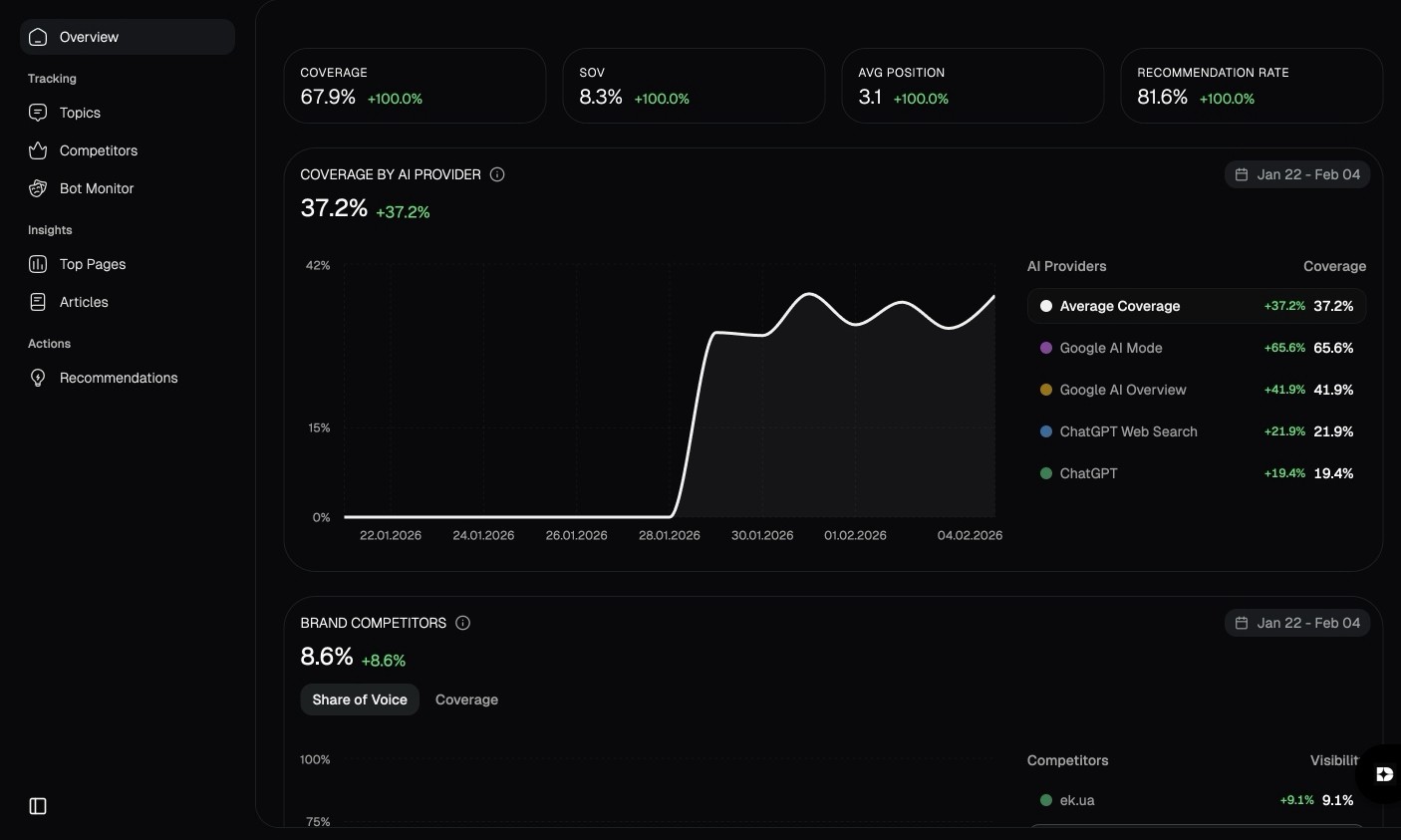
*Dabudai AI visibility overview dashboard
What Profound does better
1) Security - enterprise-level AEO (security + governance)
You are building an enterprise AEO program and security, compliance, access control, and governance are critical (for example, SOC 2 Type II, SSO via SAML/OIDC, trust center with policies and reports).
Why this matters: important for companies with strict data security needs or agencies working with top-tier clients.
2) A technical AEO layer (Agent Analytics)
You need visibility into AI crawlers, how AI “sees” your site, and how this connects to traffic and attribution (Agent Analytics).
Why this matters: you need deep analytics on which AI bots visit your site, which pages they access, and how often.
3) Content creation inside the platform
Profound allows you to create content directly in the platform. You can generate articles based on your analytics. Dabudai does not provide this feature.
Why this matters: useful if you want to quickly produce content and improve metrics through it.
4) Team operations: roles, processes, large org context (enterprise workflows)
Profound becomes a “command center” when you have many people, many brands or markets, and need access control, processes, governance, and reporting.
That’s why Profound often functions as an enterprise AI visibility platform for teams that need governance, access control, and compliance built into the workflow.
Why this matters: enterprise AEO is not “one article”. It is a program with roles, policies, approvals, and responsibility.

*Profound Agent Analytics dashboard
What is similar in Dabudai and Profound?
1) Seeing “what the user sees”, not just API output (Answer Engine Insights)
Profound focuses on analyzing answers as a real user sees them in a specific interface (which can differ from raw API answers).
Why this matters: sometimes you are “in the answer” on paper, but in real UX you are invisible or shown lower/differently. If you report to business, “what the user sees” is critical.
2) Finding and prioritizing demand: what people actually ask AI
This is a strong point: start not from “what we want to promote”, but from what people actually ask, how they phrase it, and which questions have the most potential.
Why this matters: if your problem is “we don’t know which AI topics bring the most visibility”, the discovery module saves months of random content work.
Platform comparison table
Below is a table-style breakdown for teams evaluating AI Overview optimization tools and broader AEO platforms side by side.
Criteria | Dabudai | Profound | Why this matters |
Main outcome | Improvement plan + execution + metric control | A set of modules for an AEO program | Profound creates content; Dabudai gives recommendations for content, site, and third-party sources. |
Operational loop | Measure → explain → execute → check impact | Insights + discovery + analytics + content workflows | Profound is analytics and content; Dabudai is a “growth system” via Smart Recommendations. |
Fast start | First recommendations usually after data collection: day 8–10 | Depends on module setup and processes | If you need progress “this month” — Dabudai. |
Scenario focus | ICP scenarios + competitive comparisons + buyer intent | Demand discovery (Prompt Volumes) + broad coverage | “What do people ask?” vs “how AI sees us and what to change?” |
“Why do competitors win?” | Strong focus on explaining reasons + what to fix | More insights/analysis without strict action-first framing | Without reasons, changes become chaotic. |
Smart Recommendations | Prioritized actions: site / content / outreach | Often embedded in workflows | Teams need a clear action list in the right order. |
Optimized metrics | Coverage, Share of Voice, Average Position, Recommendation + AI traffic | Visibility/insights + demand + agent analytics | “Seen” is good. “Recommended” drives demand. |
Level of analysis | Company → Topic → Prompt (easy to find drops) | More modular: engines / prompts / agents | You need to easily find “what exactly breaks”. |
Technical layer | AI crawler activity + AI traffic monitor | Agent Analytics as a separate module | Often the problem is not content, but AI accessibility. |
Content inside platform | Content as part of change plan (not a writer-in-app) | Agents/templates for content creation | Useful if you need fast production scale. |
Enterprise governance | No | Strong enterprise focus (security, access control) | For large companies, this is often a blocker. |
Best fit | Teams that want fast growth via clear actions | Teams building an enterprise AEO program | The question is not “who is better”, but “which model fits you”. |
When to choose Profound vs Dabudai?
Situation / case | Better with Dabudai | Better with Profound |
Need a fast pilot and a clear action plan, not just a dashboard | ✅ Clear “measure → explain → execute” loop + Smart Recommendations | ➖ Possible, but more focused on broad programs and modules |
Main question: “How does AI show us and what should we change to be recommended more?” | ✅ Platform logic is built for this | ➖ Gives insights, but focus is on the whole AEO program, not only your brand |
Main question: “What do people ask AI and what is the demand?” | ➖ ICP prompts possible, but discovery is not the core | ✅ Prompt Volumes as a strong discovery module |
High importance of “vs / alternatives” queries and competitor comparisons | ✅ Strong competitive layer, focus on “why competitors win” | ➖ Competitors exist in insights, but not as a dedicated displacement frame |
Agency that wants to sell AEO as its own platform | ✅ White-label, own domain/logo/colors, multi-client mode | ➖ White-label not stated |
Enterprise with strict security requirements (SSO, SOC2, governance) | ➖ Possible via custom agreements, but not the main focus | ✅ Enterprise plan with SSO/SAML + SOC2, Slack support |
Need a technical AEO layer (AI bots, logs, attribution) | ✅ AI crawler tracking + AI Traffic Monitor | ✅ Agent Analytics with deep log integration |
Want to create content directly in the platform (templates, agents, optimized articles) | ➖ More focus on recommendations; generation is secondary | ✅ Workflows + optimized articles per month on Growth |
Focus on growing AI visibility through clear “here and now” actions | ✅ Strongly action-first with a fast loop | ➖ More about a scalable program than a fast pilot |
Choose Dabudai if this sounds like you
“I don’t need a report — I need clear actions and their order”
“I want to launch a pilot fast and get first recommendations in 2 weeks”
“AI compares us with competitors — I want to know why and how to change it”
“We need higher AI attention (Share of Voice) and recommendations, not just mentions”
Choose Profound if this sounds like you
“We have an enterprise program, many people, and need processes, modules, governance”
“We want to start from what people actually ask AI (demand)”
“We need to scale content via workflows/agents/templates”
“We want a broad view across many answer engines and real user UX”
Mini glossary
Coverage — how often AI mentions your brand in relevant questions
Share of Voice (SoV) — “share of attention”: how often AI talks about you vs competitors
Average Position — if AI shows a list, your average position in it
Recommendation rate — how often AI clearly says “choose X” or puts you in “top picks”
Citations/Sources — which sites/sources AI uses to build its answer
FAQ
1) If both are about AI visibility — why not choose any?
Because the work model is different:
Dabudai = action loop (measure → explain → change → check).
Profound = platform + modules for a large program (insights + demand + agent analytics + workflow).
2) Which gives results faster “this month”?
If you need a short change loop and fast first recommendations — it is usually easier to start with Dabudai.
3) We want AI to recommend us more, not just mention us
Then you need: explanation of why you lose + prioritized change plan + control of recommendation/position metrics — this is Dabudai’s strong frame.
4) Why doesn’t AI cite our site even if content is good?
Common reasons: lack of “proof”, weak external trust (third-party), or pages are hard for AI to access/read (retrievability).
5) Do we need comparison pages for AI visibility?
Yes. This is one of the most effective formats because people ask “X vs Y” and “alternatives”. They must be honest and well structured.
7) We need security/compliance and access control — what to choose?
Enterprise platforms with governance frameworks (Profound) usually win here, but it depends on your internal requirements.
8) What is the minimum pilot to see good AI analytics?
20–30 ICP questions (prompts)
baseline: how AI answers now
a list of “what to fix”
2–3 quick changes (content/pages/proof)
re-measure
Conclusion (short)
If your question is: “How does AI show us and what should we change so AI recommends us more?” → Dabudai is built for this.
If your question is: “What do people ask AI and how to scale an enterprise AEO program?” → Profound is strong here.