Jump to
Choose SurferSEO if your main focus is content production and on-page SEO optimization (Content Editor, Content Score, internal links, AI writing).
Choose Dabudai if your main focus is winning AI answers vs competitors through a structured measure → explain → execute loop.
If your question is: “How do we optimize this article for Google?” → Surfer.
If your question is: “Why does AI recommend competitors instead of us — and what should we change?” → Dabudai.
AI has become a recommendation engine. People no longer just “google” — they ask ChatGPT, Gemini, Claude, Perplexity, and Copilot what to choose, which tools are better, and what fits their specific case.
In this landscape, an ai visibility tool becomes indispensable — not just to see where your brand appears, but to understand why AI systems recommend it and what drives those recommendations.
If your brand does not appear — or worse, is not recommended — in these answers, you are losing demand before the click.
That’s why teams are rethinking SEO. Tools like SurferSEO and Dabudai both address AI visibility — but they approach it from fundamentally different angles.
In this article, I compare Dabudai and SurferSEO in a practical format: strengths of each, key differences, and a simple guide to choose what fits your goals.
What you will find in this article
What SurferSEO focuses on (and what it does best)
What Dabudai does better (especially for AI visibility growth)
A detailed comparison table with “why it matters”
A simple decision guide (2-minute read)
FAQ for teams moving from SEO → AEO
The core difference
The simplest explanation:
SurferSEO = content optimization system.
It helps you create and optimize pages to rank better in traditional search (and increasingly AI-enhanced search).
Dabudai = AI visibility growth system.
It measures how AI answers treat your brand, explains why you win/lose, and gives a prioritized plan to improve recommendations and Share of Voice.
Surfer optimizes content.
Dabudai optimizes AI outcomes.
Both are useful — but for different stages and different problems.
What SurferSEO does better
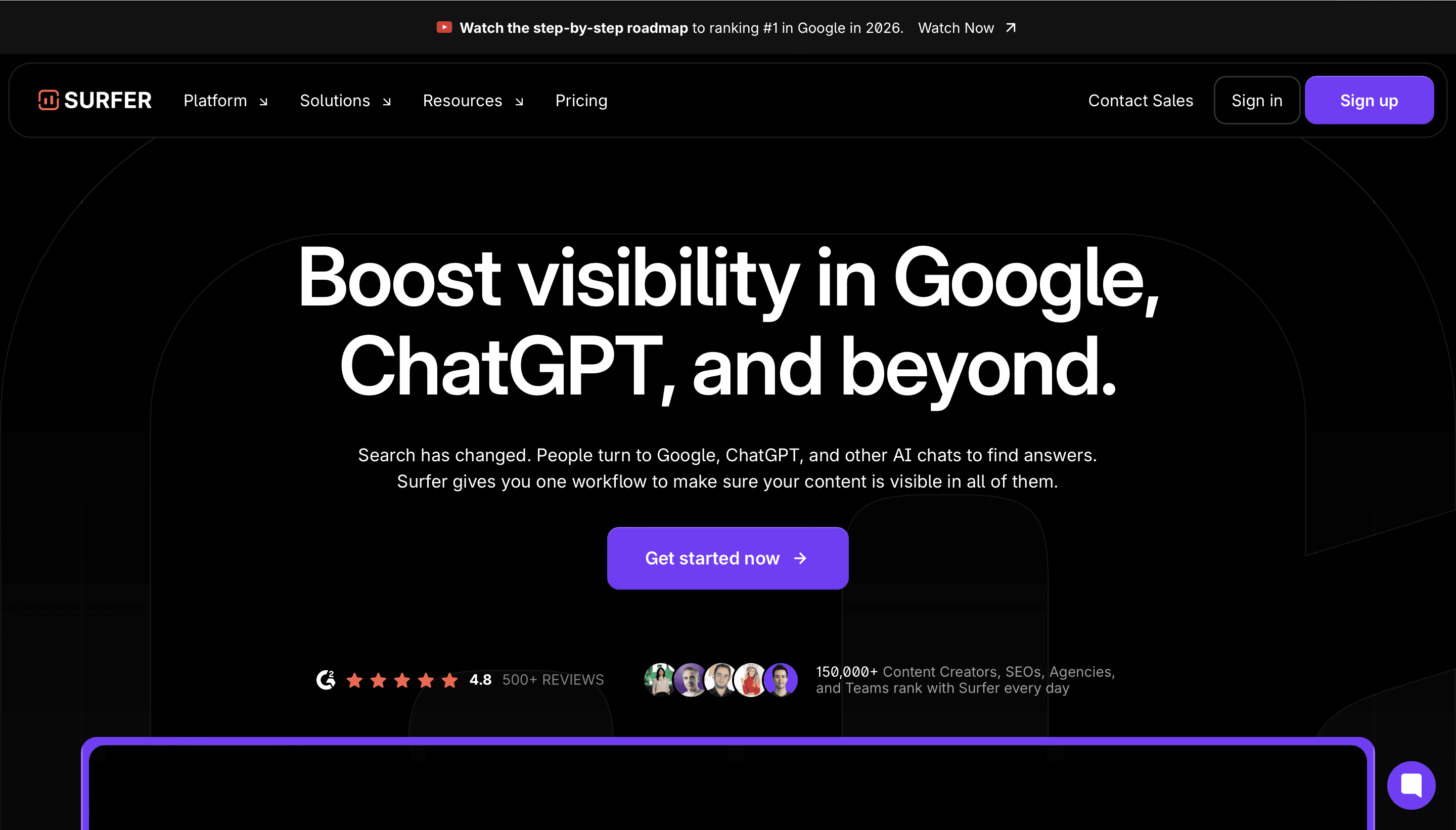
Surfer is a mature SEO platform built around content operations, and its AI Tracker extends that foundation into AI search visibility.
Surfer’s AI Tracker gives visibility into performance across AI search channels, functioning as an ai search visibility analysis tool for teams that want monitoring insights without adopting a full AEO-focused platform.
1) Content Editor + Content Score (real-time optimization)
Surfer’s Content Editor provides:
keyword and entity recommendations
content structure suggestions
word count targets
Content Score to benchmark optimization
Why this matters: if your team writes a lot of SEO content and needs structured on-page guidance, Surfer is strong here.
2) AI-powered content production workflow
Surfer includes:
Surfer AI (content generation)
rewriting and optimization features
AI detection / humanizer tools
Why this matters: if your bottleneck is content production speed, Surfer gives you a scalable writing workflow.
3) Internal linking automation
Surfer analyzes your site and suggests internal links automatically.
Why this matters: internal linking improves crawlability, context, and can indirectly affect both Google rankings and AI retrievability.
4) SEO-first ecosystem and integrations
Surfer integrates with:
WordPress
Google Docs
Contentful
API access
Why this matters: content teams can write and optimize directly inside their existing stack.
5) AI Tracker (monitoring layer)
Surfer includes an AI Tracker (beta) that allows tracking a limited number of AI prompts (depending on plan) to see how your brand appears in AI tools like ChatGPT and others.
Why this matters: it gives SEO teams simple visibility into AI search without adopting a new platform.
What Dabudai does better
Dabudai is built specifically for AI visibility and recommendation growth, not general SEO.
1) Closed-loop workflow: Measure → Explain → Execute
Dabudai does not stop at metrics. We:
Measure:
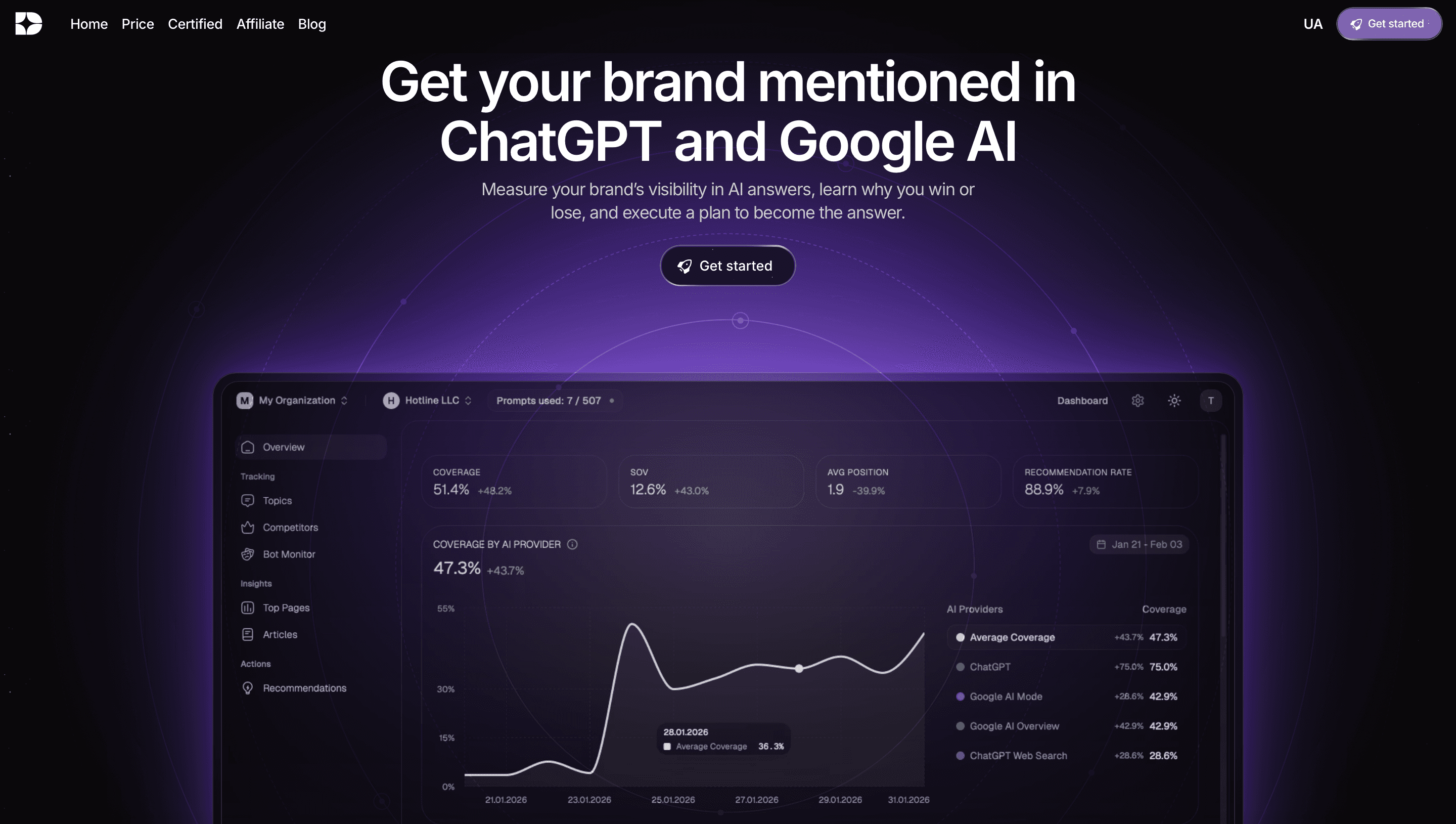
Track coverage, Share of Voice (SoV), average position, and recommendation rate across AI engines and topics.
Explain:
Show exactly where you lose (topic → prompt → competitor) and why (missing signals, content gaps, third-party sources).
Execute:
Turn this into a concrete action plan — then re-measure the effect.
Why this matters: most tools end at a dashboard. Dabudai ends with:
“What should we do next to win AI answers?”
2) Smart Recommendations = prioritized backlog (not just insights)
Dabudai generates Smart Recommendations as a ranked action list:
what to change
where (page / topic / prompt)
for which AI engine
expected impact vs effort
First recommendations appear after ~10 days of baseline tracking.
Data collected in first 10 days:
Package | AI engines | AI answers collected |
20 prompts | 4 | 1,600 |
50 prompts | 4 | 4,000 |
100 prompts | 4 | 8,000 |
200 prompts | 4 | 16,000 |
400 prompts | 4 | 32,000 |
Why this matters: AEO is a prioritization problem. Teams need a backlog that moves AI outcomes — not more graphs.
3) 3rd-party Visibility Playbook
AI answers are often influenced by external sources.
Dabudai identifies:
Top third-party platforms to appear on
Topic & angle gaps vs competitors
Specific content to publish (format, structure, target page)
Expected impact ranking
Why this matters: many teams do outreach randomly. Dabudai shows which sources actually affect AI recommendations.
4) AI Visibility Map (root-cause in 2 clicks)
View performance as:
Company → Topics → Prompts
If visibility drops, you immediately see:
which topic drives decline
which prompts are lost
which competitor gains share
what to strengthen
Why this matters: instead of average-level metrics, you get a precise attack point.
5) Built for agencies (white label in minutes)
Dabudai supports:
white-label branding
custom domain connection
multi-client setup
Why this matters: agencies can deliver AEO as their own product, increasing trust and deal size.
Platform comparison table
Criteria | Dabudai | SurferSEO | Why this matters |
Main focus | AI visibility & recommendation growth | Content optimization & SEO | Different problem statements. |
Core workflow | Measure → Explain → Execute → Track impact | Write → Optimize → Publish | One is outcome-driven; one is content-driven. |
AI visibility depth | Topic-level + prompt-level + competitor root-cause | Prompt tracking (limited by plan) | Explaining why matters more than observing. |
Recommendations | Prioritized backlog with impact/effort | On-page content guidelines | AEO requires strategic prioritization. |
Third-party strategy | 3rd-party Visibility Playbook | Not core focus | AI often cites external sources. |
Content creation | Not a writing suite | Full AI writing + optimization suite | Surfer wins in content production. |
Internal linking | Not core | Automated internal links | Surfer wins for technical on-page support. |
Best for | Teams optimizing AI recommendation outcomes | Teams scaling SEO content production | Depends on maturity and goal. |
When to choose Surfer vs Dabudai?
Situation | Better with Dabudai | Better with Surfer |
Need AI recommendation growth | ✅ | ➖ |
Need root-cause vs competitors | ✅ | ➖ |
Need prioritized action roadmap | ✅ | ➖ |
Need to scale SEO content production | ➖ | ✅ |
Need Content Score / on-page optimization | ➖ | ✅ |
Need internal link automation | ➖ | ✅ |
Agency selling AEO as product | ✅ | ➖ |
Simple choice guide (2 minutes)
Choose Surfer if:
“We need to produce and optimize a lot of SEO content.”
“Our main KPI is Google rankings.”
“We want AI-assisted content writing + internal linking.”
“AI tracking is a secondary layer for us.”
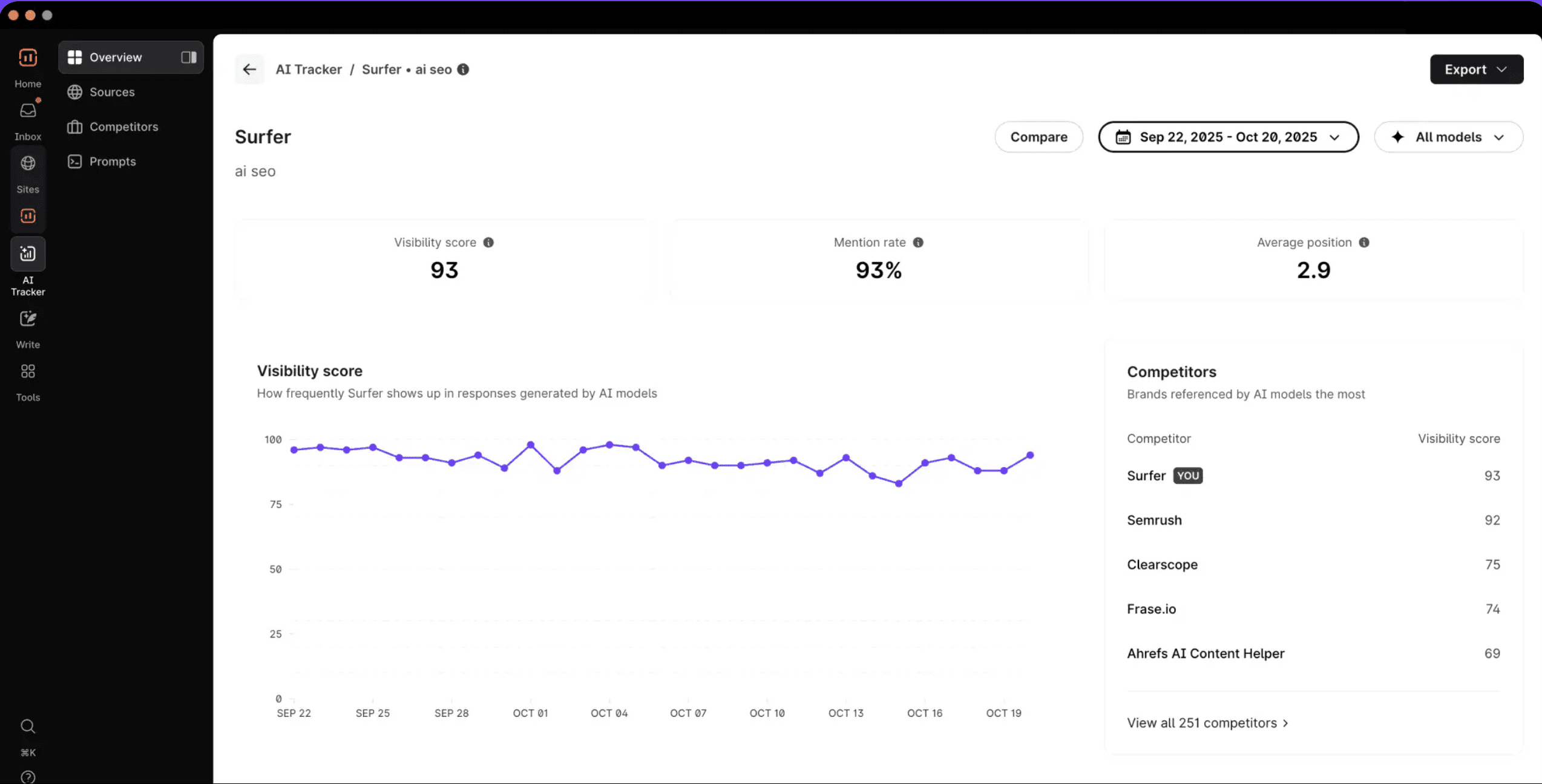
*SurferSEO AI Tracker dashboard
Choose Dabudai if:
“AI compares us to competitors — we want to win those answers.”
“We need to understand why we lose in AI responses.”
“We want prioritized actions, not just optimization hints.”
“We want higher Share of Voice and recommendation rate.”
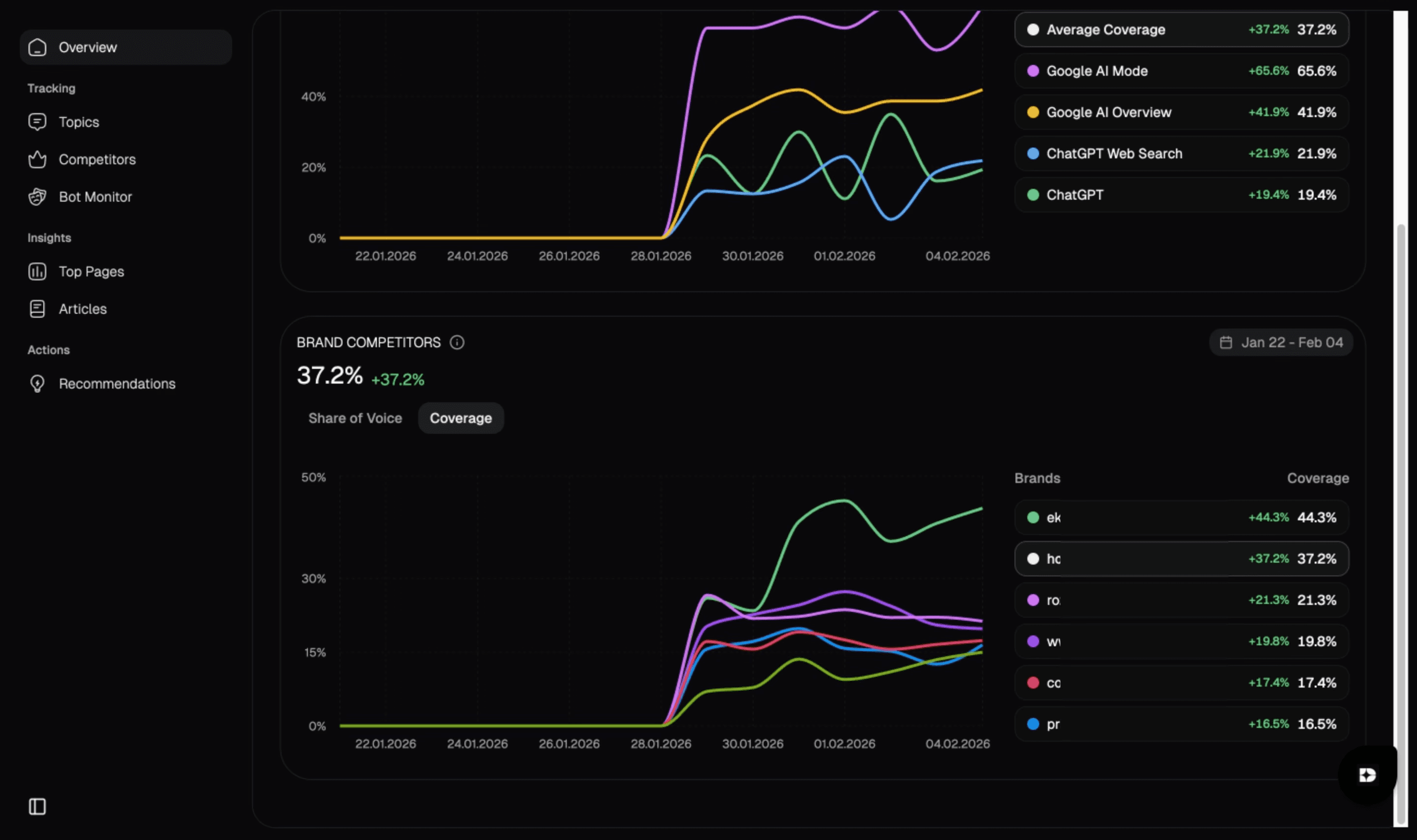
*Dabudai brand competitor analytics
FAQ
1) What are ai visibility optimization tools and which is the best?
Tools designed to improve how your content is seen and cited by AI systems are commonly called ai visibility optimization tools. Which one is the best depends on your goals: some focus on content production and SEO signals (like SurferSEO), while others focus on measuring, explaining, and growing presence in AI answers (like Dabudai).
2) Is Surfer enough for AI visibility?
Surfer gives monitoring and strong on-page optimization.
But it does not provide a full AI-specific closed-loop growth system focused on recommendation share and competitor displacement.
3) Do we need both?
Some teams use Surfer for content production and Dabudai for AI visibility strategy and competitive AEO growth.
4) What changes AI recommendations faster?
Usually: identifying missing signals, strengthening third-party presence, and fixing topic-level weaknesses — which requires root-cause analysis beyond on-page optimization.
5) Is AEO just SEO with new branding?
No. AI engines synthesize from multiple sources and weigh signals differently. Winning AI answers requires strategic visibility, not only optimized pages.
Conclusion
If your question is:
“How do we optimize content for Google and scale production?”
→ SurferSEO is strong.
If your question is:
“How does AI show us, why do competitors win, and what should we change to increase AI recommendations?”
→ Dabudai is built for that.
If you’re looking for the best ai search monitoring tool, the decision comes down to depth: Surfer’s AI Tracker is a lightweight layer inside an SEO workflow, while Dabudai is built for full AI visibility monitoring, analysis, and execution.
SEO optimizes pages. Dabudai optimizes AI outcomes.