
Jump to
Choose Dabudai if you want an action-first closed loop (Measure → Explain → Execute) with Smart Recommendations, third-party playbooks, and a clear root-cause map.
Choose Scrunch if you need a more enterprise-style monitoring and segmentation layer (presence/position/sentiment/citations), plus topic-level trend signals to help prioritize focus areas.
If the main question is: “What exactly should we change (and in what order) to win vs competitors?” → Dabudai.
If the main question is: “How are we represented across topics/personas/models/regions — and where is demand shifting?” → Scrunch.
AI discovery is shifting from “ranking pages” to “being chosen in answers.” In many categories, the first shortlist now happens inside ChatGPT, Gemini, Perplexity, and Copilot — before someone clicks a website.
That makes AI visibility a practical growth problem: you need to know where you show up, where you don’t, why competitors win, and what to change next.
This is why platforms like Dabudai and Scrunch exist. Each is an ai visibility platform that helps teams understand how AI systems present a brand — but they’re built for different operating models.
Below is a practical comparison of Dabudai and Scrunch: strengths of each, key differences, and a simple guide to choose what fits your team.
What you’ll find in this article
A quick overview of what Dabudai and Scrunch focus on
What Dabudai does better (and when it matters)
What Scrunch does better (and when it matters)
A feature comparison table with a “why it matters” column
A simple choice guide + FAQ you can scan in 2 minutes
The difference in one sentence
Dabudai is built to produce a prioritized execution backlog.
Scrunch is built to provide a segmented monitoring and insights layer at scale (including sentiment, citations, and trends).
What Dabudai does better
1) Closed-loop workflow: Measure → Explain → Execute
Dabudai doesn’t stop at metrics. We:
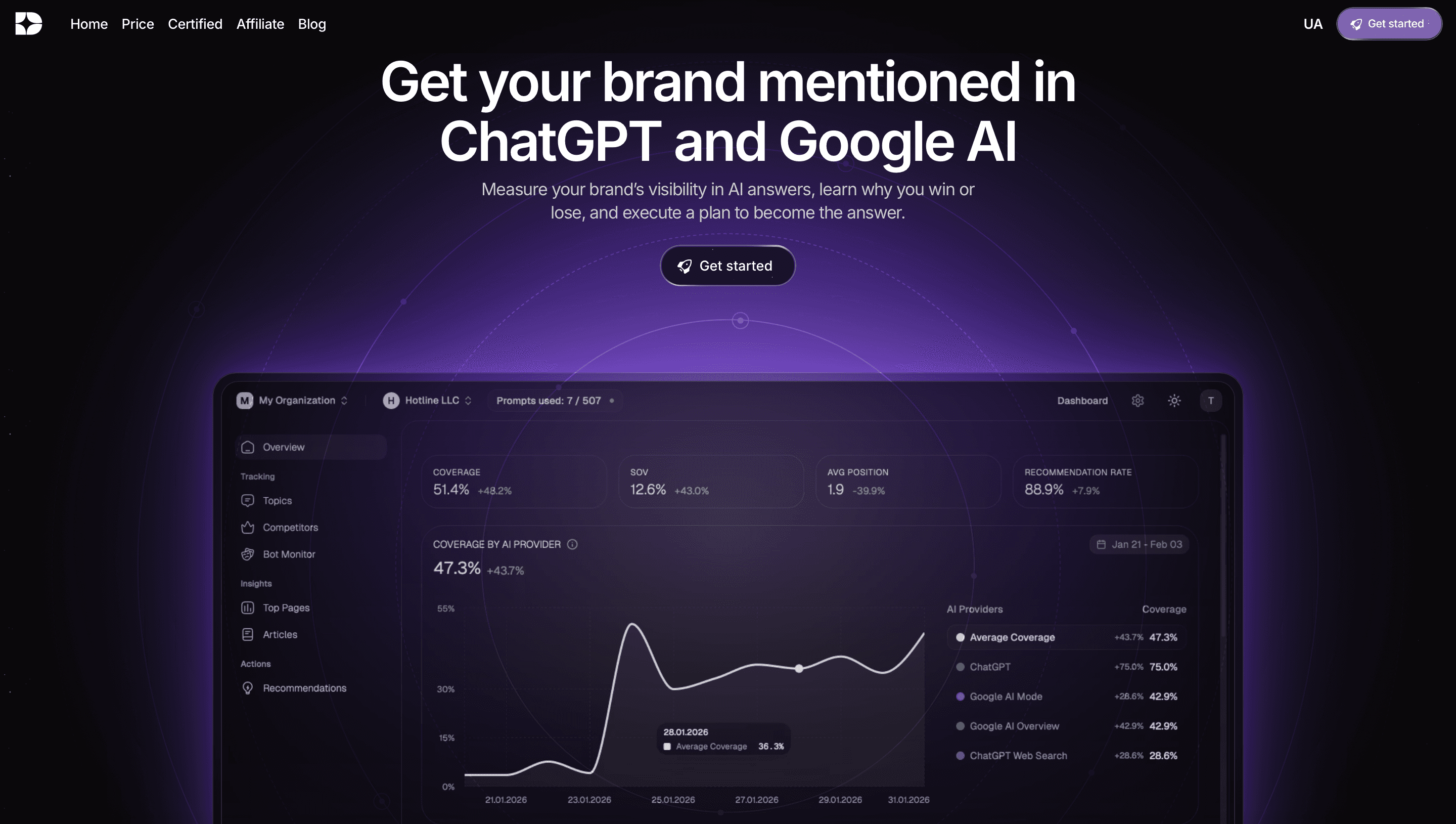
Measure: track brand visibility in AI answers (coverage, Share of Voice, average position) and changes across topics and engines.
Explain: show exactly where you lose (topic → prompt → competitor) and why (missing signals, content, or third-party sources).
Execute: turn that into a concrete action plan — then re-measure impact.
Why this matters: most tools stop at dashboards. Dabudai ends with the answer to:
“What should we do next to win AI answers?”
2) Smart Recommendations = a prioritized backlog (not “insights”)
Dabudai generates Smart Recommendations as a ranked task list:
what to change (specific action)
where (page/topic/prompt)
for which AI engine (because sources and model behavior differ)
expected impact vs effort (so teams act in the right order)
The first recommendation pack typically appears after ~10 days of tracking (baseline data collection).
Baseline data collected in the first 10 days
Package | AI providers | AI answers collected in 10 days |
Business / 20 prompts | 4 | 1,600 |
Business / Agency / 50 prompts | 4 | 4,000 |
Business / 100 prompts | 4 | 8,000 |
Business / 200 prompts | 4 | 16,000 |
Business / 400 prompts | 4 | 32,000 |
Why this matters: teams don’t need more charts — they need a change plan that actually shifts AI answers.
3) 3rd-party Visibility Playbook: where to publish + what to publish
AI answers are influenced not only by your site, but by the sources AI trusts.
Dabudai analyzes third-party sources and turns that into an actionable plan:
Top third-party sources to win AI answers (media, directories, communities, partner blogs, etc.)
Topic & angle analysis (what works for competitors, where you have gaps)
Content to publish (format, thesis, structure, target landing page, which engines matter most)
Prioritization by expected impact
Why this matters: most teams do outreach randomly. Dabudai gives a publication plan tied to AI outcomes.
4) AI Visibility Map: root-cause in 2 clicks
Dabudai provides an AI Visibility Map across:
Company → Topics → Prompts
If company-level visibility drops, you instantly see:
which topic pulls the metric down
which prompts are lost
which competitor gains share
what to strengthen (via recommendations)
Why this matters: instead of “average visibility,” you get a clear attack point.
5) Agency-ready white label: your own platform in ~10 minutes
white-label (logo/colors) in ~1 minute
custom domain connection in ~10 minutes
multi-client mode
the client sees it as your platform, not a third-party tool
Why this matters: higher trust, better close rates, and higher-priced service packaging for agencies.
What Scrunch does better
Scrunch is strongest as a monitoring and segmentation layer — especially for larger orgs that need visibility broken down by multiple dimensions.
1) Monitoring with strong segmentation (topic / persona / model / region)
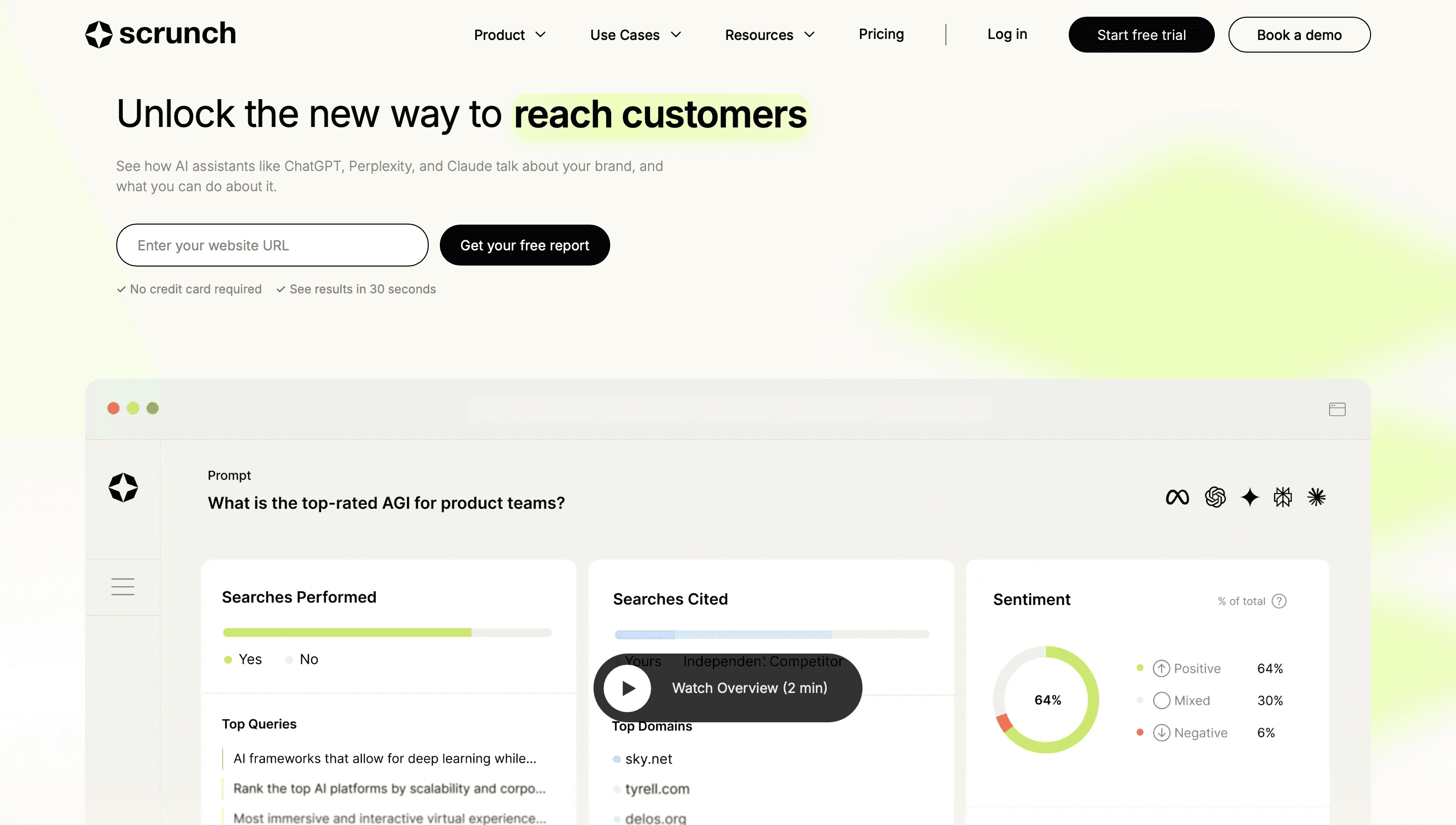
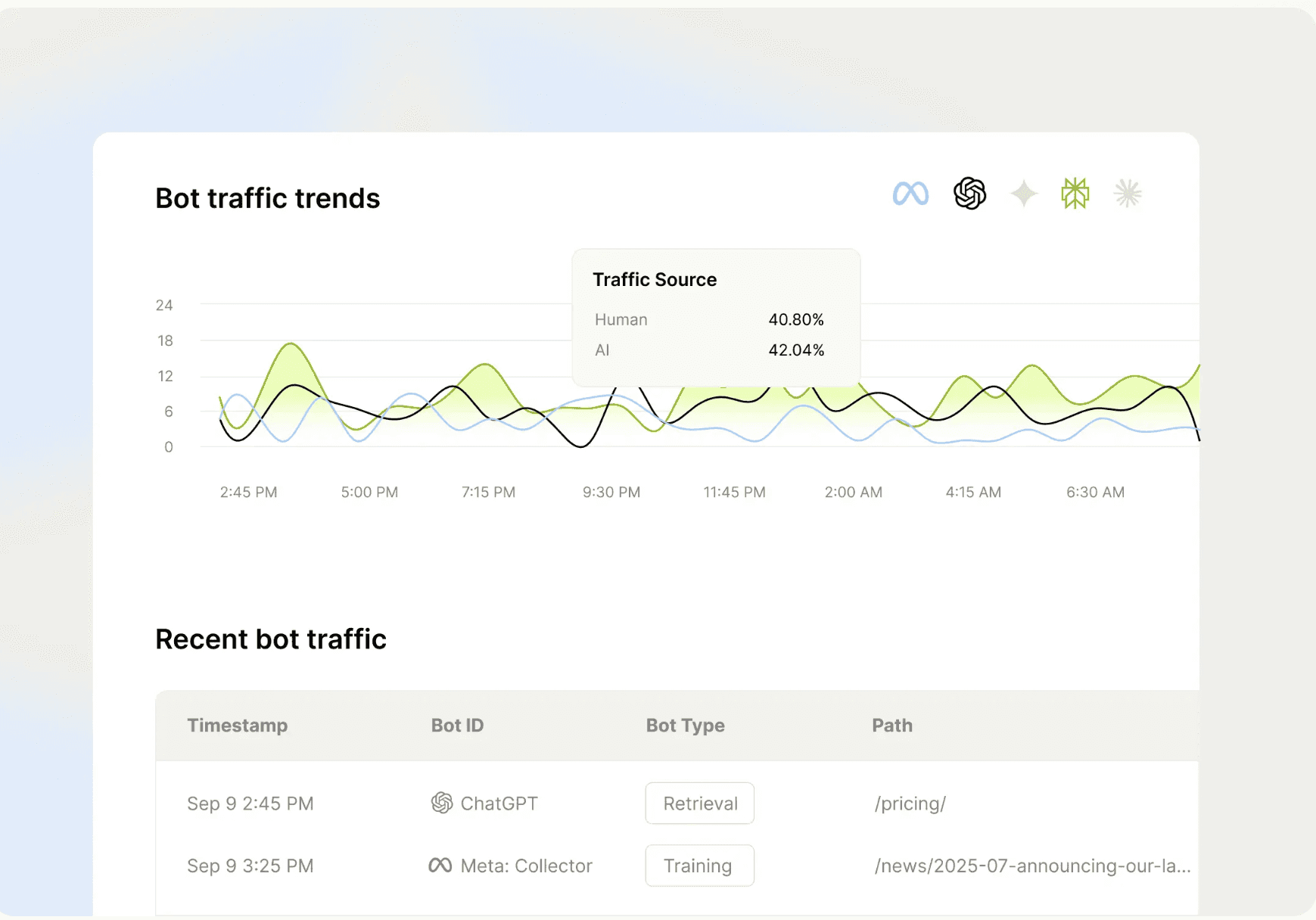
Scrunch emphasizes monitoring how your brand appears in AI answers — including presence, position, sentiment, citations — and supports segmentation by topic, persona, model, and region, plus competitive comparisons.
Why this matters: if you have multiple ICP personas, markets, or product lines, one “average” metric is not actionable. You need slices.
2) Sentiment included directly in the visibility view
Scrunch treats sentiment as a first-class part of monitoring.
Why this matters: sometimes you’re “present,” but framed negatively or with caveats — and that can hurt conversion as much as being absent.
3) Topic trends as a prioritization signal
Scrunch also leans into trend signals (topic-level interest / prompt-volume style indicators) to help teams understand where attention is growing.
Why this matters: if you’re unsure which topics deserve investment first, trends can help you prioritize before you scale execution.
4) Enterprise-style posture and packaging
Scrunch positions itself as capable of operating at scale, with an enterprise-style monitoring approach and pricing packaged for teams (their pricing page presents an entry point “starting at” level).
Why this matters: for some teams, the biggest need isn’t more recommendations — it’s reporting, segmentation, and governance-friendly monitoring.
What’s similar in Dabudai and Scrunch?
1) Both measure how AI answers represent your brand
Both are grounded in real AI answers and changes over time.
2) Both support competitive comparisons
Scrunch includes competitor comparisons in monitoring; Dabudai builds competitor displacement into the “explain → execute” loop.
3) Both treat citations as an actionable signal
Scrunch tracks citations; Dabudai turns source patterns into actions and third-party playbooks.
Platform comparison table
Criteria | Dabudai | Scrunch | Why it matters |
Main outcome | Execution plan + metric control | Monitoring + segmentation + trends | Are you buying “what to do next” or “what’s happening across segments”? |
Operating model | Measure → Explain → Execute → Track impact | Monitor + Insights + reporting | A loop shortens time from insight to outcome. |
Root-cause depth | Topic → Prompt → Competitor + missing signals | Strong segmentation + insights | Without root-cause, teams often guess what to change. |
Recommendations | Smart Recommendations (impact/effort backlog) | More insights/opportunities framing | “Seeing” is step one; execution is the hard part. |
3rd-party strategy | Full playbook (where + what to publish) | Citations + monitoring | Citations show what’s trusted; playbooks create a path to win. |
Segmentation | Company → Topics → Prompts map | Topic/persona/model/region filters | Useful when you have multiple ICPs or markets. |
Best fit | Action-first teams + agencies | Teams needing segmented monitoring at scale | Different org needs, different workflows. |
In short, both platforms work as ai visibility tracking tools, but Dabudai is built for turning insights into actions, while Scrunch is built for tracking and reporting visibility trends.
When to choose Scrunch vs Dabudai?
Situation / case | Better with Dabudai | Better with Scrunch |
Need a fast pilot + prioritized action plan | ✅ Closed loop + Smart Recommendations | ➖ Monitoring-first |
Main question: “Why do competitors win and what should we change?” | ✅ Root-cause + backlog | ➖ Strong monitoring, less action-first framing |
Need deep segmentation (persona/model/region) | ➖ Not the core pitch | ✅ Core strength |
Need topic trend signals to choose focus areas | ➖ Not the core | ✅ Strong fit |
Need a third-party publication playbook | ✅ Yes | ➖ Not positioned as a playbook |
Agency resale / white label | ✅ White-label + domain | ➖ Not core |
Simple choice guide
Choose Dabudai if this sounds like you
“We don’t need another dashboard — we need the right actions in the right order.”
“We want a fast pilot and prioritized recommendations in ~2 weeks.”
“AI compares us with competitors — we need root-cause and a displacement plan.”
“We need a third-party plan: where to appear and what to publish.”
“We want an agency-ready platform we can deliver under our brand.”

Choose Scrunch if this sounds like you
“We need segmentation by topic/persona/model/region, not one blended metric.”
“Sentiment and citations must be visible inside the same monitoring layer.”
“We want trend signals to help pick the right focus areas.”
“We’re building a broader program and need an enterprise-style visibility layer.”
FAQ
1)What are the best AI search visibility tools in 2026?
If you’re asking what are the best ai search visibility tools in 2026, the answer depends on your workflow: some teams need deeper monitoring and reporting, while others want more guidance on what to fix in order to improve AI visibility. Dabudai and Scrunch represent two different approaches to solving this problem.
2) If both are AI visibility tracking tools — why not choose either?
Because the operating model is different:
Dabudai = execution system (prioritized backlog + re-measure).
Scrunch = segmented monitoring (filters + sentiment + trends).
3) Which one helps faster “this month”?
If you need a short loop and a prioritized plan you can execute immediately, Dabudai is usually faster.
If you mainly need reporting and segmentation across multiple dimensions, Scrunch is a strong fit.
4) Does sentiment really matter in AI answers?
Yes. Being present with negative framing can be as damaging as being absent.
5) What’s the minimum pilot for AEO?
20–30 ICP prompts → baseline → 2–3 quick changes → re-measure.
Conclusion
If your question is: “Where do we lose vs competitors, what exactly should we change, and what’s the best order?” → Dabudai is built for this.
If your question is: “We need a segmented monitoring layer (persona/model/region) plus trend signals to prioritize focus areas” → Scrunch is a strong choice.