
Jump to
Choose Dabudai if you want a closed-loop workflow: measure AI visibility → understand why you win/lose → execute a prioritized plan → re-measure impact.
Choose Otterly.AI if you need a lightweight AI search monitoring tool focused on tracking prompts across multiple engines and seeing citations/links.
If the main question is: “What exactly should we change (in what order) to win AI answers vs competitors?” → Dabudai is built for this.
If the main question is: “How do we monitor AI answers across engines and track citations quickly?” → Otterly.AI is a strong fit.
AI has become a recommendation engine. People no longer just “google” — they ask ChatGPT, Gemini, Claude, Perplexity, and Copilot what to buy, which tools to compare, and what fits their case best.
If your brand does not appear in these answers, you are losing demand before the user ever visits your site.
That is why tools like Dabudai and Otterly.AI exist: they help brands understand and improve how AI describes and recommends them.
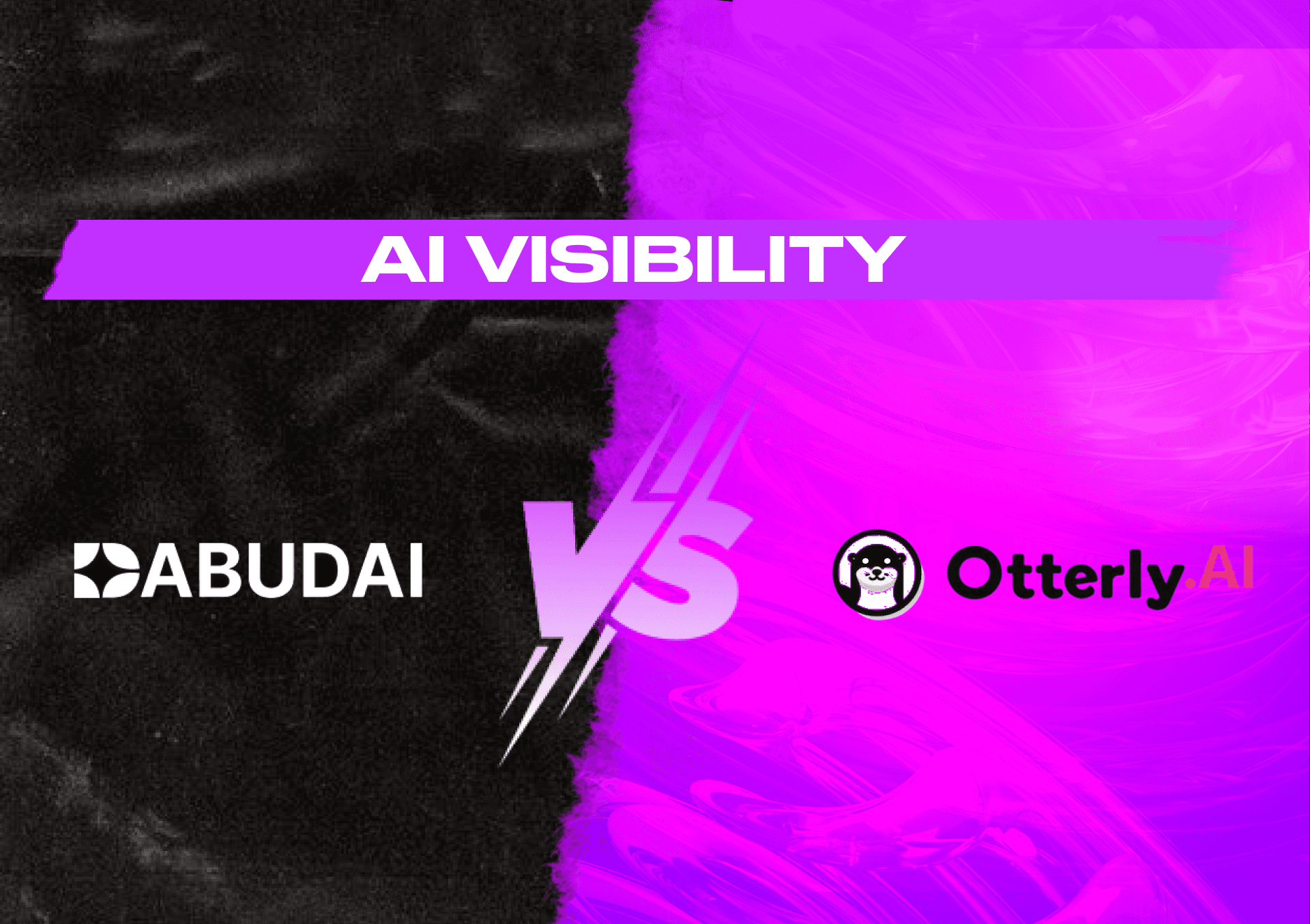
In this article, I compare Dabudai and Otterly.AI in a practical “X vs Y” format: strengths of each, key differences, and a simple guide to choose what fits you.
What you will find in this article
A quick explanation of what Dabudai and Otterly.AI focus on
What Dabudai does better (and when it matters)
What Otterly.AI does better (and when it matters)
A feature comparison table with a “why it matters” column
A simple choice guide + FAQ you can scan in 2 minutes
The question I get most often
“If both products are about AI visibility, what is the real difference?”
The simplest explanation:
Dabudai is built as a growth system:
Measure → Explain → Execute → Track impact.
Otterly.AI is built as a monitoring platform:
Track prompts across AI engines → see mentions + citations → report changes.
If your team needs more than monitoring, you’ll want an ai visibility analysis tool that explains where you’re losing (topic → prompt → competitor) and what signals are missing — not just whether you appeared in an answer.
Both can be the “right” choice — it depends on whether your team needs a plan and execution loop, or a visibility dashboard.
What Dabudai does better
1) Closed-loop workflow: Measure → Explain → Execute
Dabudai does not stop at metrics. We:
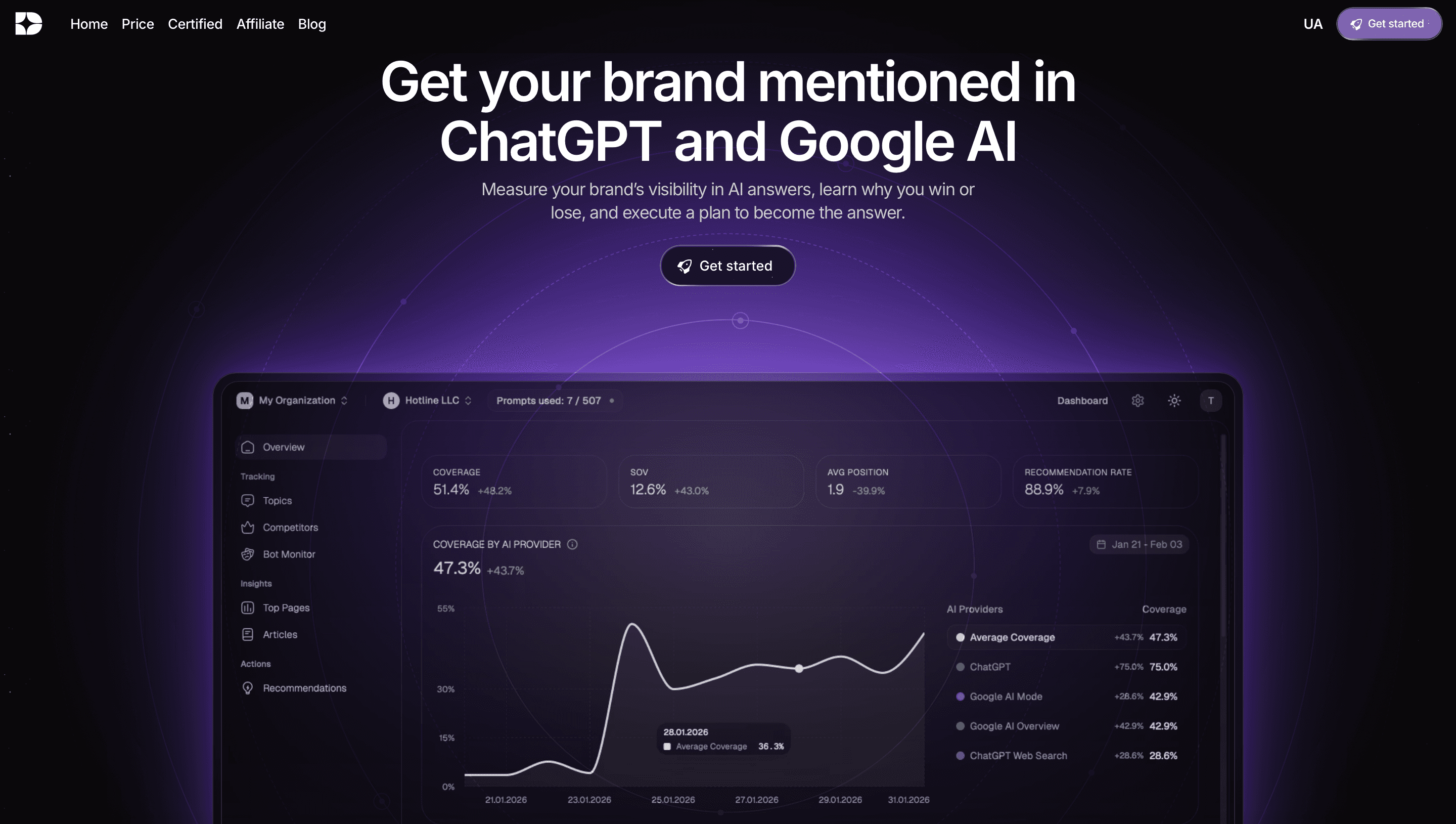
Measure: track brand visibility in AI answers (coverage, Share of Voice, average position) and changes by topics and AI engines.
Explain: show exactly where you lose (topic → prompt → competitor) and why (which signals/content/sources are missing).
Execute: convert this into a concrete action plan and then re-measure the effect.
Why this matters: most tools end at a dashboard. Dabudai ends with the answer to:
“What should we do next to win AI answers?”
2) Smart Recommendations = a prioritized action backlog, not “insights”
Dabudai generates Smart Recommendations as a prioritized task list:
what to change (specific action)
where (page/topic/prompt)
for which AI engine (because sources and model behavior differ)
expected impact / effort (so you do changes in the right order)
The first recommendation pack typically appears after 10 days of tracking (baseline data collection period).
Data collected in the first 10 days (Dabudai baseline)
Package | Providers (AI engines) | AI answers collected in 10 days |
Business / 20 prompts | 4 | 1,600 |
Business / Agency / 50 prompts | 4 | 4,000 |
Business / 100 prompts | 4 | 8,000 |
Business / 200 prompts | 4 | 16,000 |
Business / 400 prompts | 4 | 32,000 |
Why this matters: teams do not need more charts — they need a change plan that actually moves their presence in AI answers.
3) 3rd-party Visibility Playbook: where to publish + what to publish
Dabudai analyzes third-party sources that influence AI answers and turns this into an actionable plan:
Top 3rd-party sources to win AI answers: prioritized platforms (media, directories, communities, partner blogs, etc.) where your brand should appear to increase AI visibility.
Topic & angle analysis: for each topic, Dabudai shows which subtopics, phrasing, and angles work for competitors — and where your gaps are.
Content to publish: concrete recommendations on what to write/publish (format, thesis, structure, target landing page, and which AI engines it impacts most).
Prioritization: everything is ranked by expected impact.
Why this matters: many teams do outreach randomly. Dabudai shows which sources and angles actually influence whether AI “chooses” you in answers — and gives a playbook you can execute.
4) AI Visibility Map: root-cause in 2 clicks
Dabudai provides an AI Visibility Map:
Company → Topics → Prompts
If company-level visibility drops, you instantly see:
which topic pulls the metric down
which prompts are lost
which competitor takes your share
what exactly to strengthen (via recommendations)
Why this matters: instead of “average temperature”, you get a clear attack point — and you influence company-level metrics faster.
5) Agency-ready white label: your own platform in ~10 minutes
Dabudai makes agency delivery and resale easier:
white-label (logo/colors) in 1 minute
domain connection in ~10 minutes
client sees the product as your own platform, not a third-party tool
Why this matters: it increases trust, improves close rates, and lets agencies sell AEO services at a higher price point (because it looks like a real product).
What Otterly.AI does better
Otterly.AI is strongest when your goal is fast AI search monitoring with a strong focus on citations and sources.
In that sense, Otterly.AI works well as an ai search visibility checking tool when you want to quickly verify how AI engines answer key prompts — and which sources they cite.
1) Lightweight multi-engine monitoring (simple and fast to start)
Otterly.AI is designed to get you to “visibility tracking” quickly: you add a list of prompts and see how different AI engines respond over time.
Why this matters: if your team is early in AEO and you want a quick monitoring layer without building a full execution system, this can be enough to start.
2) Citation and link tracking as a core view
Otterly places strong emphasis on tracking which sources/URLs AI uses in answers (citations/links), and how this changes across engines.
Why this matters: citations are often the most actionable clue in AI search. They show you what AI trusts today — and what you need to compete with.
3) Semrush App Center distribution (useful for SEO teams)
Otterly.AI is available in the Semrush App Center, which can be convenient for teams already running their SEO workflows in Semrush.
Important nuance: Otterly itself notes that the Semrush version is a reduced feature set compared to the full Otterly platform.
Why this matters: for some teams, being inside Semrush reduces friction and speeds adoption.
4) GEO audit tool framing
Otterly also leans into a “GEO audit” concept: checklists and audit-style evaluation of readiness for AI search.
Why this matters: for many SEO teams, audit-first is a natural entry point before committing to a long-term program.
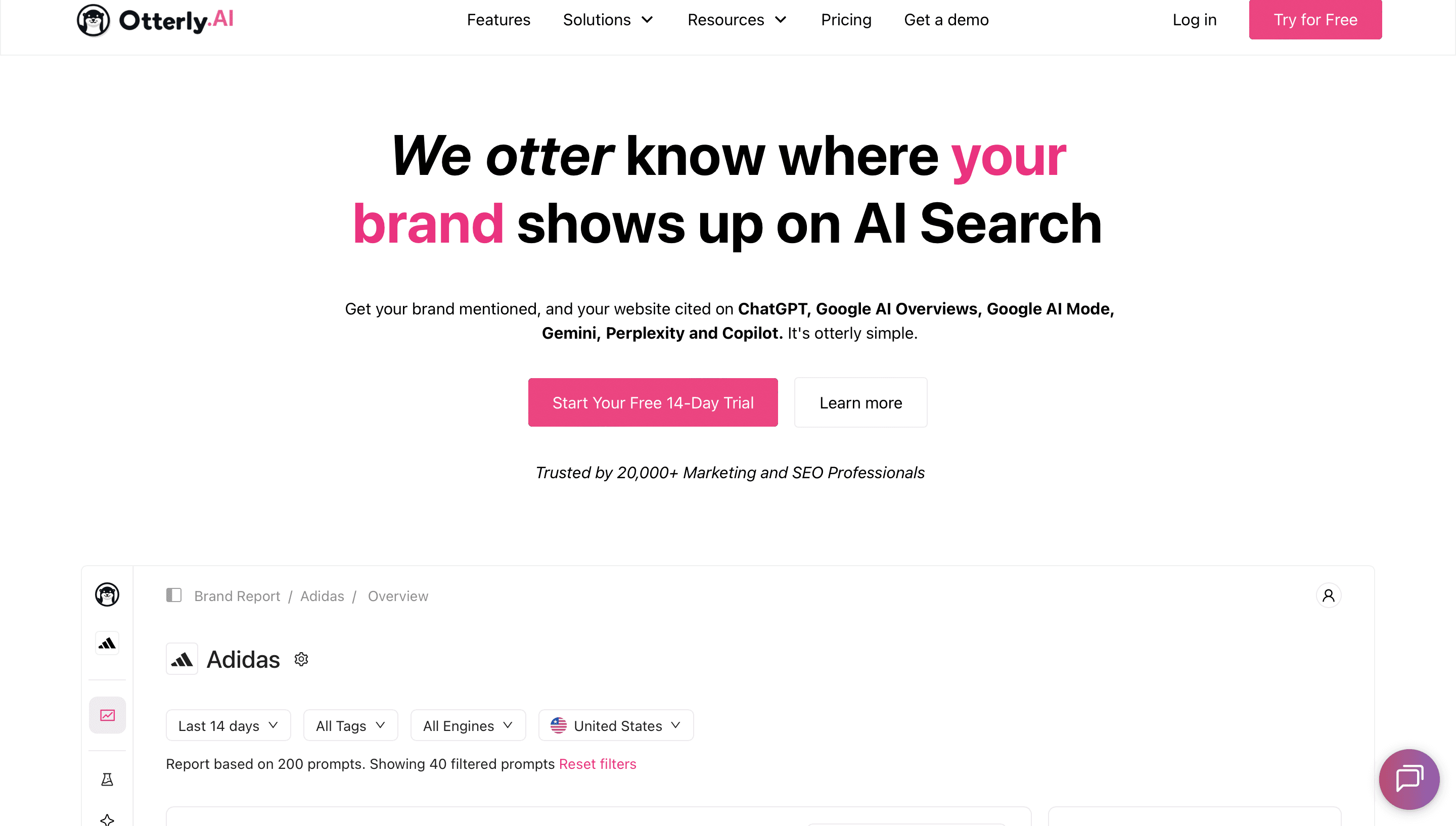
What is similar in Dabudai and Otterly.AI?
Even though the products differ in philosophy, they overlap in a few important ways:
1) Both track AI answers across multiple engines
Both tools are designed around the idea that AI answers differ between engines — and you need to monitor them separately.
Why this matters: your brand can “win” in one engine and lose badly in another.
2) Both support prompt-based monitoring
You define the prompts/questions you care about (typically ICP queries, “vs”, “alternatives”, and category intent).
This is why ai visibility checking tools typically start with prompts: they allow you to track the exact questions that generate demand and see whether your brand appears in AI-generated answers.
Why this matters: AEO is not “track everything”. It’s track the prompts that generate demand.
3) Both are built for marketers, not only engineers
Neither product is purely a developer tool. The UI/logic is designed for marketing/SEO teams.
Why this matters: AEO needs cross-functional execution, but the core workflow usually sits in marketing
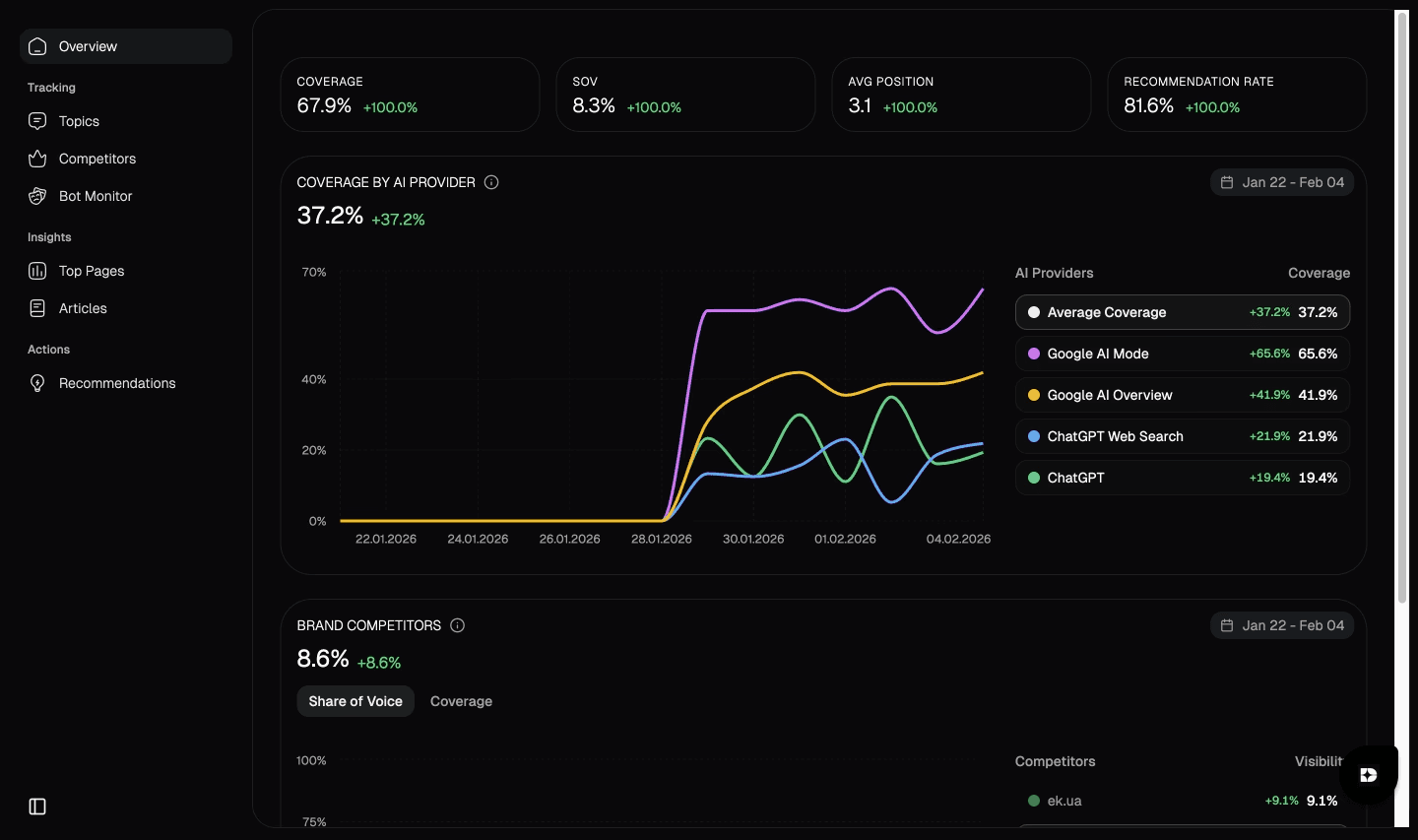
*Dabudai dashboard showing AI provider analytics
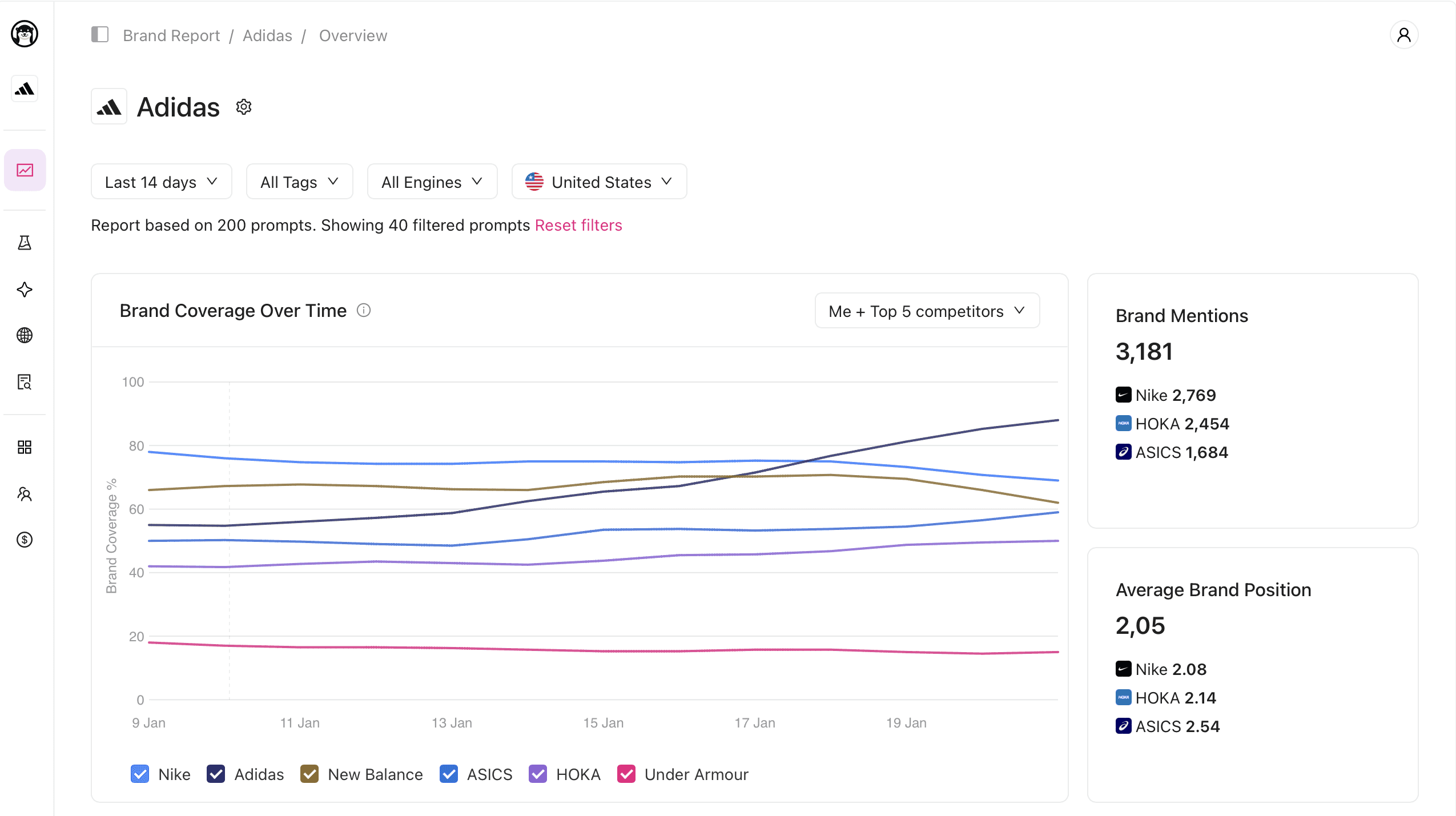
*Otterly.AI analytics dashboard
Platform comparison table
Criteria | Dabudai | Otterly.AI | Why this matters |
Main outcome | Action plan + execution + metric control | Monitoring + citation visibility | Monitoring alone rarely changes outcomes unless it becomes actions. |
Operational loop | Measure → Explain → Execute → Track impact | Track prompts → compare answers → report | Teams either move fast with a loop, or stay in “analysis mode”. |
Fast start | Baseline → recommendations after ~10 days | Very fast monitoring setup | If you need results this month, the “recommendation loop” matters. |
“Why competitors win?” | Root-cause + missing signals + what to do | More visibility than explanation | Without reasons, changes become guesswork. |
Recommendations | Smart Recommendations with impact/effort | Limited / not core | AEO is a backlog problem, not a reporting problem. |
3rd-party sources | 3rd-party Visibility Playbook | Citation visibility (what AI cites) | Seeing citations is good; knowing where to publish and what is better. |
Level of analysis | Company → Topic → Prompt (AI Visibility Map) | Prompt-based monitoring | Root-cause requires a “map”, not only prompt lists. |
Agency readiness | White-label + domain + multi-client delivery | Not a core positioning | Agencies need trust and resale packaging. |
Best fit | Teams that want to win AI answers via prioritized actions | Teams that want fast monitoring and citation tracking | Different maturity levels and different internal needs. |
When to choose Otterly.AI vs Dabudai?
Situation / case | Better with Dabudai | Better with Otterly.AI |
Need a clear action plan, not only dashboards | ✅ Closed-loop + Smart Recommendations | ➖ Monitoring-first |
Main question: “How does AI show us and what should we change?” | ✅ Built for this | ➖ You can observe, but execution is not the core |
Main question: “We need fast monitoring across engines” | ✅ Yes, but more action-focused | ✅ Strong and lightweight |
Need prioritized backlog (impact/effort) | ✅ Core feature | ➖ Not the main frame |
Need third-party publishing plan | ✅ 3rd-party Visibility Playbook | ➖ Shows citations, not a full playbook |
Agency wants a white-label platform | ✅ Yes | ➖ Not positioned for it |
Simple choice guide
Choose Dabudai if this sounds like you
“I don’t need another report — I need clear actions and their order.”
“We want to launch a pilot and get first recommendations in ~2 weeks.”
“AI compares us with competitors — we want to know why we lose and what to change.”
“We need higher AI attention (Share of Voice) and recommendations, not just mentions.”
“We want a playbook for third-party sources, not random outreach.”
Choose Otterly.AI if this sounds like you
“We want fast monitoring across ChatGPT / Google AI / Perplexity.”
“Citations and links are our main focus.”
“We already work in Semrush and want an app inside that ecosystem.”
“We want an audit-first approach and visibility tracking before building a full program.”
Mini glossary (in simple words)
Coverage — how often AI mentions your brand in relevant prompts
Share of Voice (SoV) — share of attention: how often AI talks about you vs competitors
Average Position — if AI lists options, your average ranking
Recommendation rate — how often AI explicitly recommends you (“choose X”, “best for…”)
Citations/Sources — which sites/pages AI uses as evidence to build the answer
Prompts — the questions you track (ICP, “vs”, “alternatives”, category intent)
FAQ
1) If both are about AI visibility — why not choose any?
Because the work model is different:
Dabudai = action loop (measure → explain → change → check).
Otterly.AI = monitoring + citations.
2) Which gives results faster “this month”?
If you need a short change loop and prioritized tasks — Dabudai usually gets you to action faster.
If you only need visibility monitoring — Otterly is faster to set up.
3) We want AI to recommend us more, not just mention us
Then you need: explanation of why you lose + prioritized change plan + control of recommendation/position metrics — this is Dabudai’s strong frame.
4) Why doesn’t AI cite our site even if content is good?
Common reasons: lack of “proof”, weak external trust (third-party), or pages are hard for AI to access/read (retrievability).
5) Do we need “X vs Y” pages for AI visibility?
Yes. This is one of the highest-intent formats because people ask AI “X vs Y” and “alternatives”.
6) What is the minimum pilot to see meaningful progress?
20–30 ICP prompts
baseline: how AI answers now
a list of what to fix
2–3 quick changes (content/pages/proof/outreach)
re-measure
Conclusion
If your main question is:
“How does AI show us, why do we lose vs competitors, and what should we change so AI recommends us more?” → Dabudai is built for this.
If your main question is:
“How do we quickly monitor AI answers across engines and track citations/links?” → Otterly.AI is a strong choice.
The best platform is not the one with more dashboards — it is the one that fits your current AEO maturity and operating model.