Dabudai for SMB: AI Search Intelligence Platform That Helps Your Products & Services Get Recommended in ChatGPT


Jump to
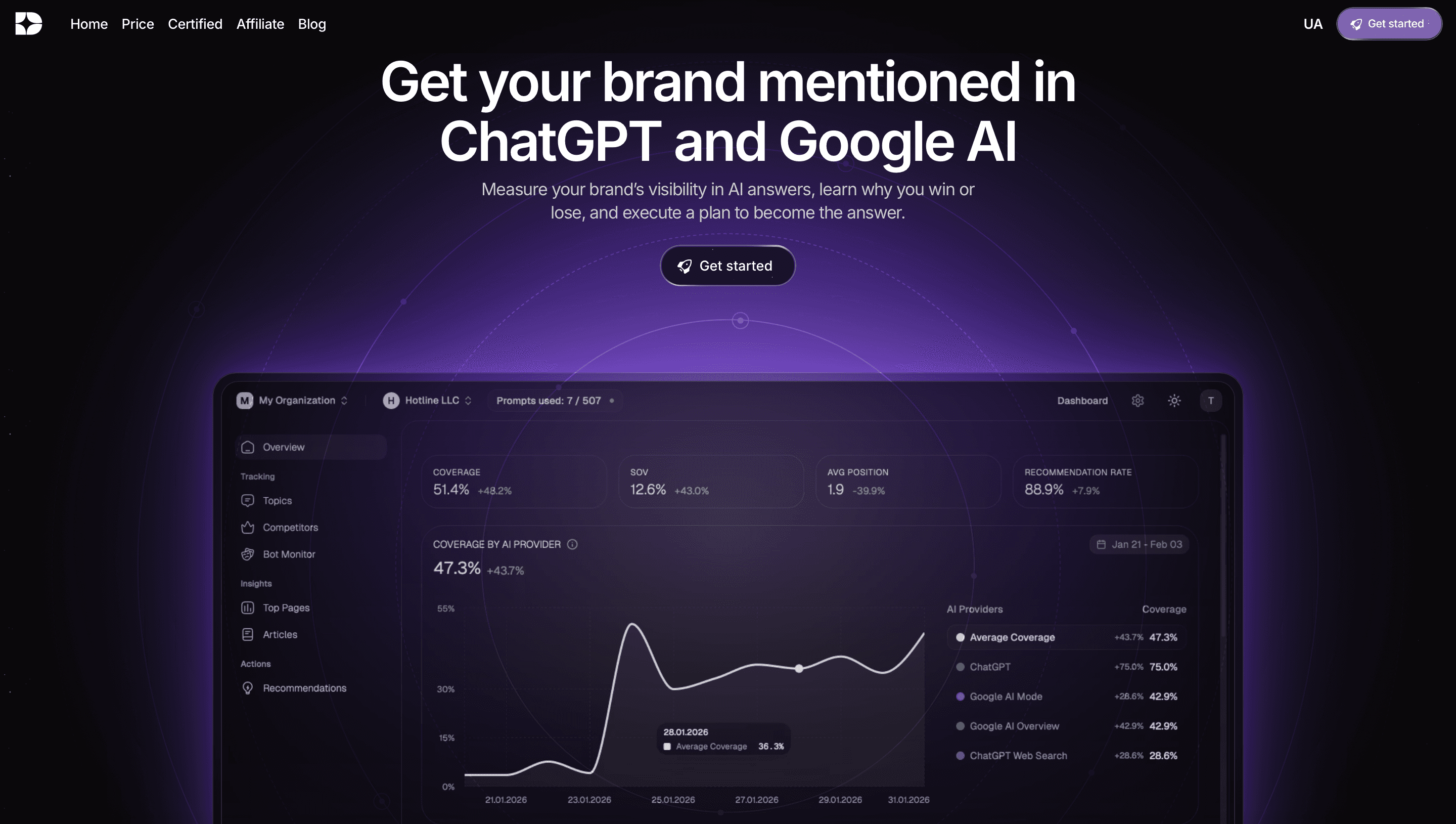
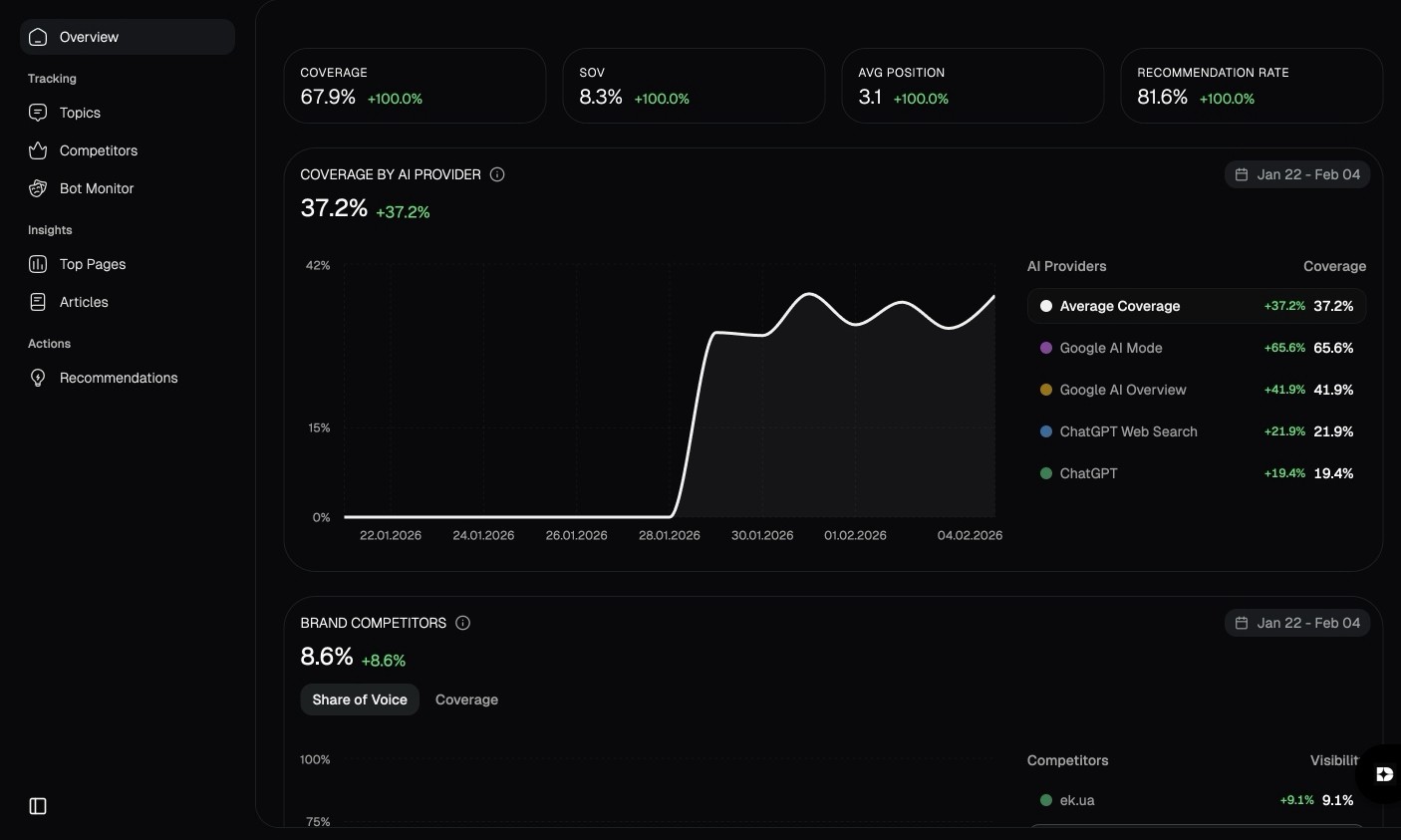
Dabudai is an AI Search Intelligence Platform built as a closed loop: Measure → Explain → Improve. It benchmarks how AI systems describe and recommend your business (products/services) versus competitors — then delivers Smart Recommendations and a prioritized plan to increase Share of Voice, Average Rank Position, and Recommendation Rate across ChatGPT, Gemini (AI Overviews), and Perplexity.
AI search is becoming the fastest-growing “decision layer” for SMB customers. Instead of reading ten websites, people ask ChatGPT, Gemini (Google AI Overviews), and Perplexity questions like:
“What’s the best option near me for …?”
“Which service provider should I choose?”
“Compare these two companies”
“What’s the best product for my needs and budget?”
“Who should I trust for this problem?”
This shift is especially visible in ai services for small businesses — customers increasingly ask AI to recommend providers, compare options, and validate trust before they ever visit a website.
If AI answers don’t mention your business — or if they recommend competitors — you lose demand before the first call, message, or click.
Dabudai helps your business become the recommended answer.
Best for SMBs selling products & services
Best for: service businesses, local businesses, SMB eCommerce brands
Works across: ChatGPT, Gemini (AI Overviews), Perplexity
Improves: Share of Voice (AI), Average Rank Position, Recommendation Rate
Measure: how AI describes and recommends you vs competitors
Explain: why competitors win (narrative gaps, proof gaps, source gaps)
Improve: a prioritized action plan (website, content, third-party trust)
Why SMBs lose in AI answers (even with a good website)
SMBs often lose in AI answers not because they’re worse — but because their signals are weaker, scattered, or hard for AI to trust.
Common reasons:
Your “what you do” is unclear or inconsistent across pages and profiles
Competitors have stronger proof (reviews, testimonials, “best of” lists, directories)
Your site doesn’t answer buying questions (pricing, process, guarantees, comparisons)
AI pulls from third-party sources where you’re missing or underrepresented
Your services/products are not represented with AI-retrievable pages
AI doesn’t answer like Google. It synthesizes the most consistent and “trustworthy” story it can find — and recommends the brands with the strongest signals.
For local services vs product brands (two different AI intents)
For local and service businesses (“near me” intent)
AI often answers questions like:
“best [service] near me”
“top-rated [service] in [city]”
“how much does [service] cost in [city]”
“who is best for [problem]”
To win these, your business needs:
clear service pages
strong reviews and trust signals
consistent business information across sources
For product brands (eCommerce intent)
AI often answers questions like:
“best [product] for [use case]”
“best [product] under $X”
“[product] vs [product]”
“is [brand] worth it?”
To win these, your brand needs:
clear product positioning and use-case pages
proof (reviews, comparisons, benchmarks)
buyer guides and comparison content
What Dabudai is NOT
Dabudai isn’t:
a keyword rank tracker
a classic SEO suite
a mentions-only monitoring tool
a one-time audit that ends in “insights”
Dabudai is an AI Search Intelligence Platform built to improve recommendations, not just visibility
How Dabudai works for SMBs (the 3-layer platform)
1) Context Layer: Brand Truth (your real offer, in customer language)
Dabudai helps you define Brand Truth for your products/services:
what you sell and who it’s for
top customer questions, objections, and decision criteria
your differentiators (why choose you)
proof: reviews, ratings, testimonials, case studies, warranties, guarantees
competitor comparisons: what you do better, what you do differently
This is the foundation for how AI should describe you.
2) Intelligence Layer: scenario tracking + competitor benchmarking
Dabudai tracks the exact kinds of prompts customers use when buying products/services:
Local/service purchase intent
“best [service] near me”
“top-rated [service] in [city]”
“[service] price in [city]”
“best [specialist] for [problem]”
“[service] vs [alternative]”
Product purchase intent
“best [product] for [use case]”
“best [product] under $X”
“[product] vs [product]”
“is [brand] worth it”
“where to buy [product]”
Mid-sized / B2B “platform” intent
“best ai demand forecasting platforms for mid-sized companies 2025”
These platform-level queries often generate AI shortlists and category comparisons — especially in B2B buying cycles.
Then Dabudai measures what matters:
Coverage across topics and prompts
AI traffic to your website (where available)
3) Action Layer: Smart Recommendations (what to change first)
Most SMBs don’t need more data. They need a clear plan.
Dabudai generates Smart Recommendations and a prioritized improvement plan across:
Website optimization
Content marketing
Media / third-party outreach
And you can validate impact with before/after tracking.
Smart Recommendations: typically after baseline collection (6–8+ days)
To deliver high-quality recommendations, Dabudai needs baseline AI answer data.
Smart Recommendations typically become available after baseline collection (6–8+ days of data) — often around ~10 days from start, depending on scenario volume and AI systems tracked.
Dabudai explains WHY competitors get recommended (and what to fix)
AI visibility isn’t random. There are reasons.
Dabudai identifies:
Missing proof
Where competitors have stronger evidence:
reviews and ratings
testimonials and case studies
guarantees, warranties, certifications
before/after examples and results
Missing pages
Where your website doesn’t support buyer questions:
pricing pages (or pricing approach)
process pages (“How it works”)
FAQs based on real questions
comparisons (“X vs Y”, “alternatives”)
“best for” pages (segments, use cases, locations)
Weak consistency
Where your messaging differs across:
your website
business profiles
directories
social pages
third-party sources
Competitor source advantage
Where competitors appear in trusted sources — and you don’t.
This is how Dabudai turns monitoring into a strategy.
AI Visibility Map: see exactly where you’re losing
Dabudai organizes your performance into an AI Visibility Map:
Company → Topics → Prompts → Models
So you can quickly identify:
which services/products are underrepresented in AI answers
which prompt scenarios exclude you
which competitors dominate recommendations
where performance differs across ChatGPT vs Gemini vs Perplexity
This means you fix the right thing first — without guessing.
The most effective improvement model for SMBs: prompt → page → metric
For SMBs, the fastest wins usually come from building the pages that AI needs to recommend you.
Here’s the logic:
Identify the buyer prompt you want to win
Create (or improve) the page AI should cite
Measure the change in Share of Voice, ranking, and recommendations
High-Intent Prompts → Best Page to Publish → Goal Metric
High-intent customer prompt | Best page / asset to publish | Primary goal metric |
“best [service] near me” / “top-rated [service] in [city]” | Location/service page + review highlights + FAQ + service area details | Recommendation Rate + Average Rank Position |
“[service] price in [city]” / “how much does [service] cost?” | Pricing page (range/approach) + “what’s included” + common pricing FAQs | Coverage + Average Rank Position |
“who is the best [specialist] for [problem]” | Problem-to-solution page + proof (before/after, results) + credentials | Recommendation Rate |
“[your business] vs [competitor]” | Comparison page (differences, use cases, pros/cons) + proof + neutral tone | Share of Voice (AI) + Average Rank Position |
“alternatives to [competitor]” | Alternatives page (top options + when to choose each) + your differentiators | Share of Voice (AI) + Coverage |
“is [brand] worth it?” / “can I trust [business]?” | Proof / trust page (reviews, guarantees, policies, certifications, case studies) | Recommendation Rate |
“best [product] for [use case]” | Use-case landing page + buyer guide + proof (reviews, benchmarks) | Coverage + Recommendation Rate |
“best [product] under $X” | Budget-based guide + product lineup page + comparison table | Coverage + Average Rank Position |
“how to choose a [service/product]” | Buyer guide with decision criteria + FAQs + examples | Coverage |
AI-ready service/product page checklist (SMB version)
AI systems prefer content that is structured, consistent, and proof-led.
To make a service or product page AI-retrievable, it should include:
a 1-sentence summary of what you do at the top
clear “who it’s for” + use cases
pricing approach (or range) + what’s included
process steps (“How it works”)
proof blocks (reviews, testimonials, results)
FAQs based on real customer questions
a comparison section (vs alternatives)
trust signals (certifications, guarantees, service area, policies)
This is the type of page AI can quote confidently.
AI-Ready Page Elements: What to Include and Why It Works
Page element | Why it matters for AI visibility | Example / implementation |
1-sentence “what we do” summary (top of page) | Improves retrievability and reduces ambiguity about category fit | “We provide [service/product] for [audience] to solve [problem].” |
“Who it’s for” + use cases | Helps AI match you to buyer intent scenarios | Segments, industries, job-to-be-done bullets |
Pricing approach (or range) + what’s included | AI and buyers reward clarity; reduces decision friction | Ranges, packages, inclusions, “starting from” + FAQ |
How it works (process steps) | Makes your offer easy to explain and cite | 3–5 steps with timelines and deliverables |
Proof blocks | Strongest lever for recommendations (trust + credibility) | Reviews, testimonials, results, before/after, case studies |
FAQs based on real questions | Directly matches common prompts; increases coverage | Pricing, timelines, guarantees, service area, comparisons |
Comparisons / alternatives section | Captures high-intent “vs” and “alternatives” queries | Neutral tone, pros/cons, “when to choose what” |
Trust signals | Improves credibility and local/service relevance | Certifications, guarantees, policies, location/service area, contact info |
Clean structure (headings, lists, short paragraphs) | Makes content easier to extract and quote accurately | H2/H3 sections, bullets, TL;DR blocks, scannable layout |
Third-party trust signals AI actually uses
AI tends to trust and reuse information from:
review and rating platforms
local business profiles
industry directories
“best of” lists and roundups
reputable media mentions
certifications and associations pages
For SMBs, these sources often decide whether AI recommends you — even more than your blog content.
Third-Party Trust Signals → What to Improve → Why AI Cares
Source type | What to improve | Expected effect in AI answers |
Reviews & ratings platforms | Volume, freshness, specificity (use-case mentions), response rate | Trust ↑, Recommendation Rate ↑ |
Local business profiles | Consistency (name/address/phone), categories, service areas, photos, FAQs | Local relevance ↑, “near me” inclusion ↑, Coverage ↑ |
Industry directories | Accurate positioning, categories, proof points, consistent descriptions | Category fit ↑, Share of Voice ↑ |
“Best of” lists & roundups | Presence in roundups, clear differentiators, quotable proof | Shortlist inclusion ↑, Average Position ↑ |
Reputable media mentions | Consistent narrative, clear claims, proof-backed stories | Trust ↑, Recommendation Rate ↑ |
Certifications & associations | Verification pages, badges, credential details, “why it matters” explanations | Credibility ↑, Recommendation Rate ↑ |
Case studies / testimonials (on-site + off-site) | Concrete outcomes, before/after, measurable results, industry relevance | Proof strength ↑, Recommendation Rate ↑ |
What outcomes Dabudai drives for SMBs
Dabudai helps SMBs selling products/services:
get included in AI recommendations more often (Share of Voice)
rank higher in AI shortlists (Average Position)
earn more direct recommendations (Recommendation Rate)
improve coverage across high-intent buying prompts
drive more website visits from AI platforms (where available)
All through the closed loop: Measure → Explain → Improve.
Who this is for (SMB)
This use case is ideal for:
service businesses (home services, agencies, clinics, professional services)
local businesses competing for “near me” demand
SMB ecommerce brands selling products online
founders and operators who need a clear prioritized plan
Want to see how AI recommends your business vs competitors — and what to fix first? Start tracking and get Smart Recommendations after baseline data collection.
FAQ
Can Dabudai help with “near me” queries?
Yes. Dabudai tracks “near me” and location-based scenarios and benchmarks how AI recommends your business versus competitors.
Do we need to publish pricing to get recommended?
Not always. But AI strongly prefers clarity. Even a pricing approach, ranges, or “what’s included” section can improve recommendations.
What matters more for AI: reviews or content?
Both matter — but for SMBs, third-party proof (reviews, ratings, directories) often has the biggest influence on recommendations.
How do comparisons influence AI recommendations?
Comparisons (“X vs Y”, “alternatives”) are some of the highest-intent prompts in AI search. Winning those scenarios often increases Recommendation Rate and Average Position.
Can Dabudai help if we operate in multiple cities?
Yes. Dabudai can track prompts and visibility across different location-based scenarios and service areas.
What if competitors are bigger brands?
Dabudai helps you find the scenarios where you can win: niche use cases, local intent, specific buyer problems, and trust signals that AI values.