Dabudai for SaaS Marketing Teams: AI Search Intelligence Platform to Get Recommended in ChatGPT


Jump to
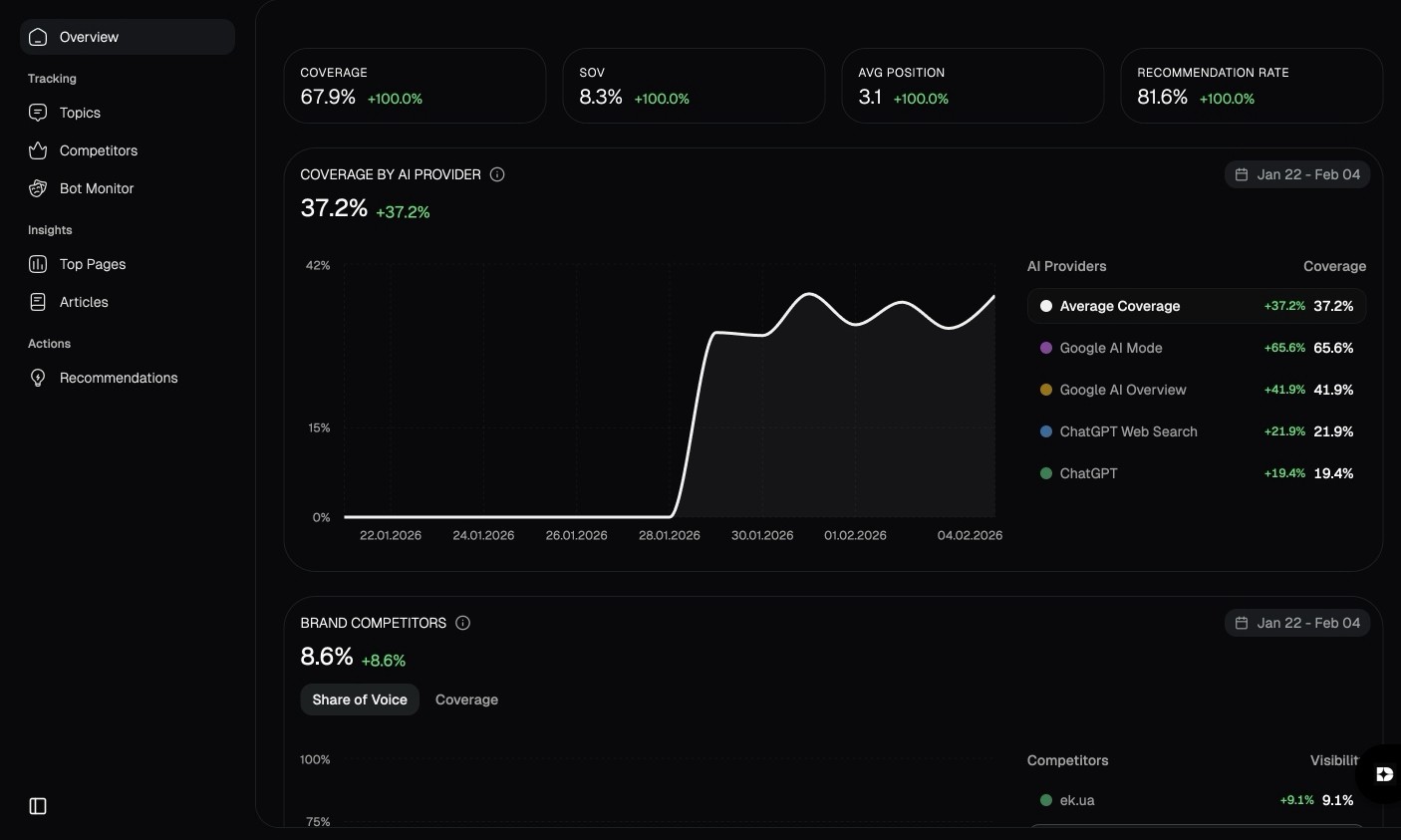
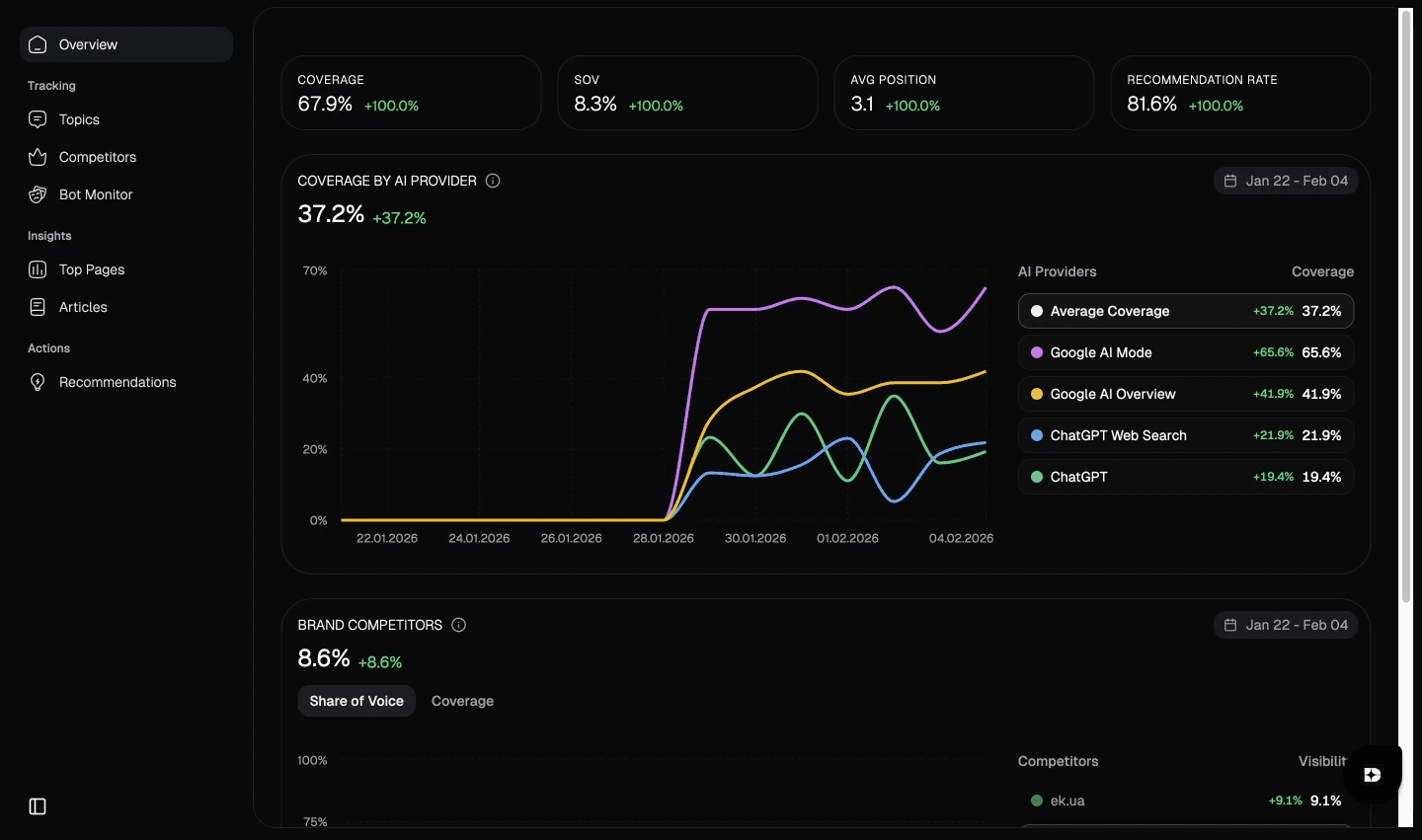
Dabudai is an AI Search Intelligence Platform built as a closed loop: Measure → Explain → Improve. We benchmark your SaaS against competitors across buyer-intent scenarios in ChatGPT, Gemini (AI Overviews), and Perplexity — then deliver Smart Recommendations and a prioritized plan to increase Share of Voice, Average Rank Position, and Recommendation Rate.
AI search has become a new consideration channel for SaaS buyers. Instead of scrolling through ten Google results, people ask ChatGPT, Gemini (Google AI Overviews), and Perplexity questions like:
“What are the best tools for …?”
“Compare X vs Y”
“What should I choose for my team size?”
“What are the alternatives?”
“Which platform is best for my use case?”
If AI answers don’t include your SaaS — or if AI recommends competitors — you lose demand before the click.
That’s exactly what Dabudai is built to fix.
Dabudai is an AI Search Intelligence Platform — not a dashboard
Most tools can show you data. Dabudai is designed to drive measurable improvement.
Dabudai is built as a clear closed loop:
Measure → Explain → Improve → Validate results
That’s the core difference.
Dabudai vs Typical AI Monitoring Dashboards (for SaaS)
What SaaS teams need | Typical AI monitoring dashboard | Dabudai |
Track how your SaaS appears in AI answers | ✅ Yes | ✅ Yes |
Benchmark competitors across buyer-intent scenarios | ⚠️ Partial | ✅ Full (scenario-based competitive tracking) |
Measure Share of Voice, Average Rank, and Recommendation Rate | ✅ Yes | ✅ Yes |
Explain why AI recommends competitors (gaps + drivers) | ❌ No / shallow | ✅ Yes (narrative gaps, proof gaps, source gaps) |
Get a prioritized plan (Smart Recommendations) | ❌ No | ✅ Yes (website, content, third-party outreach) |
Validate impact with before/after tracking | ⚠️ Not systematic | ✅ Yes (closed loop: Measure → Explain → Improve) |
Time-to-first-value | ⚠️ Undefined | ✅ Smart Recommendations typically in ~10 days* |
*Timing depends on the number of scenarios and AI models being tracked.
Why SaaS brands lose in AI answers (even with strong SEO)
Even if you rank in Google, AI can still:
exclude you from “best tools” shortlists
mislabel your category or oversimplify your positioning
recommend competitors because they dominate “trusted sources”
use outdated messaging or old comparisons
miss your strongest proof (case studies, reviews, benchmarks, numbers)
The key is this:
AI doesn’t answer like Google.
AI composes answers based on:
what it considers “trusted enough”
how consistent your brand narrative is across sources
how clearly you fit into a category
the density and quality of proof
how readable and retrievable your content is
Traditional SEO tools rarely explain why AI chose a competitor — and what to change to fix it.
What Dabudai is NOT
To make the category clear, here’s what Dabudai is not:
Not a keyword rank tracker
Not a one-time AEO audit
Not a “mentions-only” AI monitoring tool
Not a classic SEO suite
Dabudai is an AI Search Intelligence Platform built to improve recommendations, not just visibility.
How Dabudai works for SaaS marketing (the 3-layer platform)
Dabudai connects your market context to AI answers — then turns insights into a prioritized execution plan.
1) Context Layer: Brand Truth
Dabudai helps you define Brand Truth for your SaaS:
ICP pains, questions, and buying scenarios
common objections and competitive comparisons
canonical positioning and key messages
proof points: case studies, reviews, benchmarks, citations
This is the foundation. If Brand Truth isn’t defined, AI will build your narrative for you — and it often won’t match your GTM strategy.
2) Intelligence Layer: AI scenario tracking + competitor benchmarking
Dabudai runs ICP-aligned scenarios that mirror real SaaS buyer intent:
“best [category] tools”
“best [category] SaaS tools”
“best [category] SaaS tool for SMB / mid-market / enterprise”
“[competitor] alternatives”
“[you] vs [competitor]”
“how to choose a [category] SaaS tool”
“top [category] SaaS platforms 2026”
“is [competitor] good for [use case]?”
“pricing and pros/cons of [category] SaaS tools”
“which [category] SaaS tool is easiest to implement?”
“best [category] SaaS tool for [industry]”
“best [category] SaaS platform for [integration stack]”
For early-stage teams evaluating top ai search analytics platforms for saas startups, these ICP-aligned scenarios are the fastest way to see whether you’re being shortlisted — and which competitors AI consistently prefers across engines
Then Dabudai benchmarks you against competitors and measures what matters:
Coverage across topics and prompts
AI crawler activity + AI traffic to your website
3) Action Layer: Smart Recommendations + execution plan
Most teams don’t need more charts. They need a prioritized list of changes.
Dabudai generates Smart Recommendations and a prioritized improvement plan across:
Website optimization
Content marketing
Media / third-party outreach
And you can validate impact with before/after tracking.
Smart Recommendations in ~10 days (time-to-first-value)
To produce high-quality recommendations, you need baseline AI answer data.
That’s why Dabudai typically delivers the first Smart Recommendations in ~10 days after tracking starts — once baseline data collection and competitor benchmarking are complete.
Timing depends on how many scenarios and AI models you track, but the goal is clear: fast time-to-first-value and a prioritized action plan you can execute.
Dabudai explains WHY you win or lose (not just what happened)
AI visibility isn’t random. There are reasons.
Dabudai explains why you win or lose by identifying:
Narrative gaps
Where AI misrepresents your category, positioning, or key differentiators — and repeats competitor narratives instead.
Proof gaps
Where competitors have stronger evidence (reviews, case studies, benchmarks, media mentions) and AI trusts them more.
Source gaps
Which third-party sources influence recommendations — and where your brand is missing.
This is what turns monitoring into a strategy.
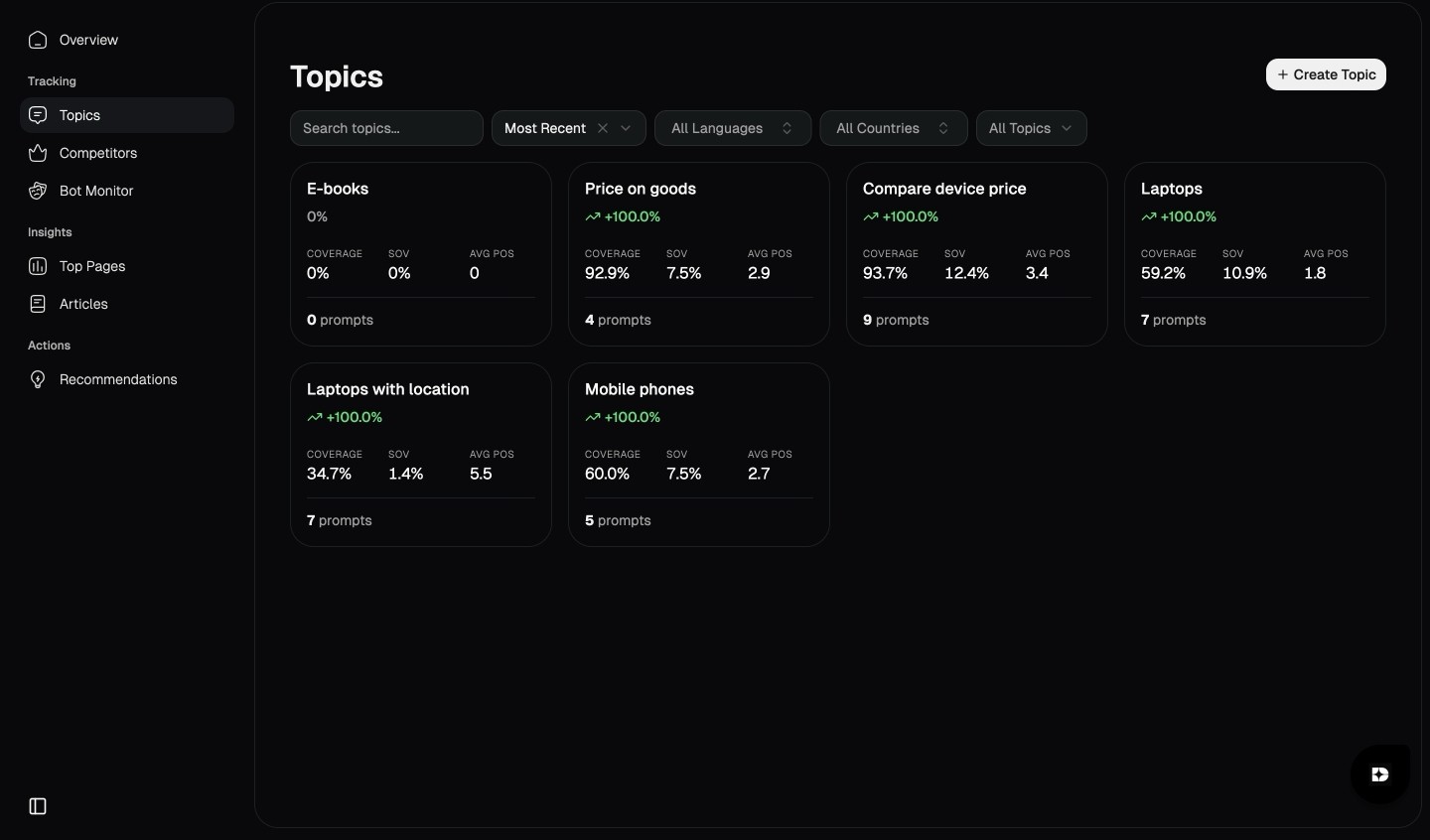
AI Visibility Map: see exactly where you’re losing (company → topics → prompts)
Dabudai organizes insights into an AI Visibility Map:
Company → Topics → Prompts → Models
So your team can quickly see:
which topics are dragging down Share of Voice
which prompts exclude you from the shortlist
where competitors are overrepresented
how results differ across ChatGPT vs Gemini vs Perplexity
This makes AI visibility actionable — not guesswork.
What Dabudai helps SaaS marketing teams do better
1) Win the shortlist (not just get mentioned)
In SaaS, being included in “best tools” lists is the new top-of-funnel.
That’s why Dabudai focuses on metrics tied to consideration:
Share of Voice (AI)
Average Rank Position
Recommendation Rate
Visibility is good. Recommendations are what move pipeline.
2) Replace AI guesswork with a prioritized improvement plan
Dabudai doesn’t just tell you “what happened.” It tells you what to do next:
what to change on your website
what pages to create or rewrite
what content topics will create the biggest lift
what proof assets are missing
what third-party sources to strengthen
This turns AI visibility into an execution roadmap for your marketing team.
3) Connect PMM, SEO, Content, Brand, and Demand Gen around one system
AI search touches:
positioning (PMM)
website messaging and pages (web team)
content planning (content/SEO)
proof and trust signals (brand/PR)
conversion narratives (demand gen)
Dabudai provides one shared view and one prioritized plan — so teams ship the right changes instead of random content.
4) Track AI crawler activity and AI traffic to your website
SaaS teams want proof that AI visibility connects to real outcomes.
Dabudai tracks:
AI crawler activity (how AI systems and bots interact with your site)
AI traffic patterns (visits and behavior from AI platforms)
This helps you tie AI visibility work to measurable website impact.
5) Benchmark against competitors continuously
AI answers change. Competitors change messaging. Sources change.
Dabudai keeps benchmarking your SaaS against the competitors that matter — so you can:
catch drops early
see who’s gaining in Share of Voice
understand what changed and why
protect your category narrative
What outcomes Dabudai drives for SaaS
Dabudai helps SaaS marketing teams:
increase Share of Voice in AI answers
rank higher in AI shortlists (Average Rank Position)
earn more direct recommendations (Recommendation Rate)
expand coverage across ICP topics and prompts
drive more website visits from AI platforms
And most importantly: do it systematically through the Measure → Explain → Improve loop.
SaaS Outcomes, Metrics, and What Typically Moves Them
If you’re trying to compare ai monetization solutions for saas, it helps to separate two layers: (1) demand capture (getting included in AI shortlists and recommendations) and (2) conversion proof (reviews, case studies, benchmarks, and third-party sources AI can cite).
Outcome for your SaaS | Metric Dabudai tracks | What typically improves it |
Get included in AI shortlists | Share of Voice (AI) + Coverage | “What is / Compare / Alternatives” pages, clearer category fit, topic-level content clusters, and consistent Brand Truth across key sources. |
Rank higher in AI recommendations | Average Rank Position | Better retrievability (structure, headings, FAQs), stronger comparisons, and improved on-page proof blocks. |
Earn more direct recommendations | Recommendation Rate | Proof density (reviews, case studies, benchmarks), third-party trust signals, and narrative alignment across sources. |
Own the category narrative | Topic-level Share of Voice (AI) | Closing narrative gaps with PMM-led messaging, topic authority content, and better coverage of ICP buying scenarios. |
Drive qualified AI traffic to your website | AI traffic + engagement patterns | Landing pages built for AI retrieval, clearer conversion paths, and proof-led pages that match buyer intent. |
Who this is for
This use case is ideal for:
CMO / VP Marketing
Head of Growth
Product Marketing (PMM)
Content & SEO leads
Competitive intelligence / strategy
Want to see where AI gives your buyers to competitors — and what to fix first? Book a demo or start tracking to get baseline benchmarking and Smart Recommendations after data collection.
FAQ
Is Dabudai an SEO tool?
No. Dabudai is not a keyword rank tracker or a classic SEO suite. It measures and improves how AI systems represent your brand in answers and recommendations.
Which AI systems do you track?
Dabudai supports scenario tracking across major AI platforms, including ChatGPT, Gemini (Google AI Overviews), and Perplexity.
When will we see first results?
The first Smart Recommendations are typically available in about ~10 days after tracking starts, once baseline data collection and competitor benchmarking are complete. After that, results depend on how quickly improvements are implemented.
How is this different from AI monitoring dashboards?
Dashboards show data. Dabudai provides a closed loop: Measure → Explain → Improve → Validate before/after. It’s built to drive execution and measurable lift.
What are the best LLM optimization tools for SaaS in 2026?
When people search for best llm optimization tools for saas 2026, they usually mean tools that help a SaaS brand get accurately described, cited, and recommended in AI answers. The best choice depends on whether you need a closed-loop system (measure → explain → improve → validate) or a lighter monitoring dashboard — and how much competitor benchmarking and scenario coverage you need.